2026. October 31. Saturday
Katona József Museum "Cifrapalota" Exhibition Place - Kecskemét
 |
Address: 6000, Kecskemét Rákóczi út 1.
Phone number: (76) 480-776
E-mail: cifrapalota.kecskemet@gmail.com
Opening hours: Tue-Sun 10-17
|
The exhibition has closed for visitors.
2010.03.19. - 2010.05.09.
Share it, if you like it:


Museum tickets, service costs:
|
Program ticket
|
450 HUF
|
|
|
Guide
|
1000 HUF
|
|
|
Wedding photographs
|
5000 HUF
|
The second era concerning the Kecskemét Artist Colony is rather unprocessed and in consequence of this, it is also less known than the first connected to Béla Iványi Grünwald. The core of the era was the painter of the Great Planes, the retired professor Imre Révész and his students.
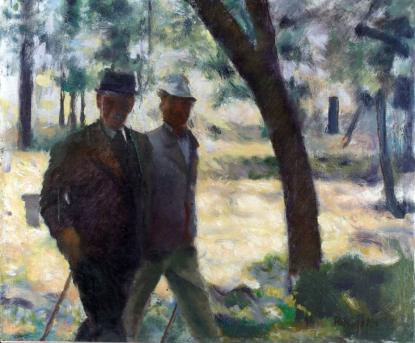
The existence of the colony was endangered after WWI and the 1918-1919 revolutions following it. It was mostly due to Révész that the colony survived. The Kecskemét Artist Colony of the Royal Hungarian National Academy of Fin Arts came to being. Many of the students who enrolled the academy (eg. István Benyovszky, József Csillag, János Hajnal, István Harczi, Vladimir Szabó, Nándor Lajos Varga, Imre Zsögödi Nagy ) moved to Kecskemét (eg Mátis Kálmán, Prohászka József , Irma Vujovich). After Révész retired in 1932 the colony experienced a kind of withdrawal, but some of the students continued the work (the master himself only moved to Kecskemét after WWII). Even more, led by Ferenc Redő, some attempted to revive the colony.
The era is described through the memories of the contemporaries. We can read an except from the painter Kálmán Csizmadia of Szeged, written in 1975: '(Révész) lived in a separate cottage with his family and came to the colony twice a week officially, wearing a hat, and smoking his pipe. He came to correct out works. But in reality he visited us more than twice. He paid attention to everyone, He was interested in what we were doing, and he expressed his approval or disapproval. He also gave orders. He demanded me to draw at the beginning, draw with coal, pencil or pen. I practiced these for long, painting only came later. I did a lot of coal drawings of heads and nudes. Later on I did the same with oil, pastel and aquarelle. The daily routine at the colony was the following: in the morning we painted heads, nudes or did figural paintings; in the afternoon we went to the countryside to paint nature; in the evening we painted nudes and did studies again. The master followed Munkácsy’s traditions and we looked at him with admiration, as he was a Munkácsy scholar. He also believed in fulfilling free theories considering art. He himself preferred realist topics, dealing with the peasantry. The gypsy quarter proved to be a good topic to us, too. The gypsies were happy to come over to us and were happy to express how wonderful people the master was. Indeed, he was a joyous man, a real Hungarian man with Hungarian origins. With his simple attitude he was able to create a friendly environment with those who surrounded him. He could not have hurt anyone.
A colourful catalogue was published on occasion of the exhibition with a number of reproductions and documents, but a selection of the writings of the era is there to read, too.
The art historian Gyergyádesz László Jr.
|
|