2026. October 8. Thursday
Museum Kiscell - Municipal Picture Gallery Budapest - Budapest
 |
Address: 1037, Budapest Kiscelli utca 108.
Phone number: (1) 388-7817, (1) 250-0304
E-mail: fovarosi_keptar@mail.btm.hu
Opening hours: 01.04-31.10.: Tue-Sun 10-18
01.11-31.03.: Tue-Sun 10-16 |
The exhibition has closed for visitors.
2014.04.03. - 2014.04.27.
Share it, if you like it:


Museum tickets, service costs:
|
Ticket for adults
|
900 HUF
|
|
|
Ticket for students
|
450 HUF
|
|
|
Group ticket for students
|
350 HUF
|
|
|
Ticket for pensioners
|
450 HUF
|
|
|
Ticket for families
|
1300 HUF
|
/ family
|
|
Photography
|
500 HUF
|
|
|
Video
|
1500 HUF
|
Tamás Jovánovics's works - any of his typologies that come to mind- have a characteristic feature, that is, there is a kind of rigour, and a consistent set of rules present at the same time, as well as the the resolution and tilt of rules..
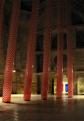
Take, for example, the gigantic column installation set up here. If you think about it, a bar is one of the most stable, most physical phenomenons. Here they are translucent, ethereal and yet they tilt above the straight diagonal axis.
This tilting probably rhymes with space itself, where these columns has been set up, because the history of this church differ about from churches' typical function to the extent like the airy columns themselves..
As for the paintings, painting is almost always rectangles enclosed colours and shapes grouped according to a certain theme the painter wants to reveal. However, with Tamás, there are some colour and shapes, but somehow, this basic form, this mythical square continually breaks up, fall apart, bends , and tilt.
Perhaps thinking of this square as a starting point, the great theorist of Renaissance, Alberti defined painting as window. Contrary to Alberti's definition, Tamás uses painting not as a "window", but rather as a "door" or column. We look out the window, the events are outside the window, there are OUT SIDE. And also, ypu can go through door, IN and OUT.
(Details from the thoughts the mathematician Endre Szemerédi shared at the opening ceremony)
|
|