2026. May 22. Friday
Geographic Museum of the Tuszazug - Tiszaföldvár
|
|
Address: 5430, Tiszaföldvár Kossuth u. 101.
Phone number: (56) 470-135, (56) 570-525
E-mail: tf.muzeum@gmail.com
Opening hours: Tue-Sat 9-12, 13-17
On prior notice: beyond the opening hours as well! |
The exhibition has closed for visitors.
2008.02.15. - 2008.04.20.
Share it, if you like it:


Museum tickets, service costs:
|
Ticket for adults
|
300 HUF
|
|
|
Group ticket for adults
(min. 10 people)
|
150 HUF
|
|
|
Ticket for students
|
150 HUF
|
|
|
Ticket for children
|
150 HUF
|
|
|
Ticket for pensioners
|
150 HUF
|
|
|
Guide
|
2000 HUF
|
|
|
Photography
|
2000 HUF
|
|
|
Video
|
5000 HUF
|
The new exhibition in the renewed Geographical Museum of Tiszazug leads us to the other side of the world, to Oceania.
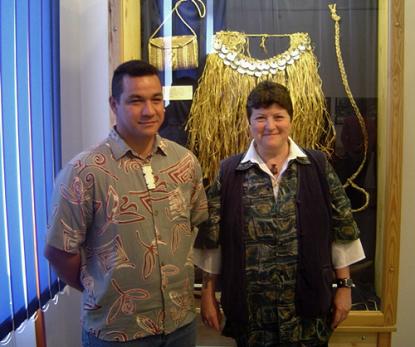
The exotic material, by the aim of the director Mária Béres, brings the message of the world to the Tiszazug. In the first room the collection of ethnographer Ferenc Ignácz can be seen, who has lived in Australia and Papua and New Guinea since 1980, and is kept now in the Town Museum of Gödöllő.
The second part of the exhibition is the result of the work of archaeologist Judit Antoni and her husband Alfred Falchetto Teururai, an artist from the Marquesas Islands. Judit Antoni always feels sympathy for that culture and as being an archaeologist of the neolithic age could profited from the studying that area which kept a way of life similar to the neolithic period.
She made her husband acquaintance in the Marquesas Islands, who has French origin on the father's side, but he was born as a descendant of a family formerly ruled Tahiti on the mother's side. Alfred Falchetto Teururai got involved with the traditional art of his people by the influence of his wife. His forms were shaped by some European pieces left on the island, hundreds of years old traditional works of art and the European collections. His dreams take shape mainly in coco-nut, wood and bone pieces, which are the traditional materials in Oceania. It is true that some of that materials are hard to find, because the islanders are collecting more and more just to provide souvenirs for the tourists, thereby endangering several species.
Apart from that more and more young artists appear in Oceania who live in a modern world but extend their knowledge from studying their own people's roots. One of them is Alfred whose work is inspired with the love of nature and his country - being this nature in Polynesia or in Hungary, living here or there: the motifs always recall his country of origin.
The exotic material, by the aim of the director Mária Béres, brings the message of the world to the Tiszazug. In the first room the collection of ethnographer Ferenc Ignácz can be seen, who has lived in Australia and Papua and New Guinea since 1980, and is kept now in the Town Museum of Gödöllő.
The second part of the exhibition is the result of the work of archaeologist Judit Antoni and her husband Alfred Falchetto Teururai, an artist from the Marquesas Islands. Judit Antoni always feels sympathy for that culture and as being an archaeologist of the neolithic age could profited from the studying that area which kept a way of life similar to the neolithic period.
She made her husband acquaintance in the Marquesas Islands, who has French origin on the father's side, but he was born as a descendant of a family formerly ruled Tahiti on the mother's side. Alfred Falchetto Teururai got involved with the traditional art of his people by the influence of his wife. His forms were shaped by some European pieces left on the island, hundreds of years old traditional works of art and the European collections. His dreams take shape mainly in coco-nut, wood and bone pieces, which are the traditional materials in Oceania. It is true that some of that materials are hard to find, because the islanders are collecting more and more just to provide souvenirs for the tourists, thereby endangering several species.
Apart from that more and more young artists appear in Oceania who live in a modern world but extend their knowledge from studying their own people's roots. One of them is Alfred whose work is inspired with the love of nature and his country - being this nature in Polynesia or in Hungary, living here or there: the motifs always recall his country of origin.
|
|