2026. November 11. Wednesday
Hamza Collection and Jász Gallery - Jászberény
 |
Address: 5100, Jászberény Gyöngyösi út 7.
Phone number: (57) 503-260, (57) 503-261
E-mail: hamzamuzeum@gmail.com
Opening hours: 01.04.-31.10.:Tue-Sat 10-18
01.11.31.03.: Tue-Sat 10-16 |
The exhibition has closed for visitors.
2007.06.24. - 2007.07.01.
Share it, if you like it:


Museum tickets, service costs:
|
Ticket for adults
|
400 HUF
|
|
|
Group ticket for adults
(min. 10 people)
|
200 HUF
|
|
|
Ticket for students
|
200 HUF
|
|
|
Ticket for pensioners
|
200 HUF
|
|
|
Guide
|
500 HUF
|
|
|
Photography
|
500 HUF
|
The artist was born in Hódmezővásárhely in 1903. He loved the Jászság as a child. His grandfather, Hamza Pál was a teacher. He attended the third grade of primary school at the People's School in Abonyi Street and graduated from the Verseghy Ferenc Grammar School.
At the Academy of Fine Arts, his painting teacher was Csók István, his sculptor teacher was Kisfaludy-Stróbl Zsigmond. In the meantime he also attended Law School. After receiving his diploma, he received scholarship to Paris in 1926. He attended the Grande Chaumiére. He participated at a few collective exhibitions but he held his first independent exhibition in 1929 in the Miromesnil Gallery in Paris. Critics took him for a representative of the Pairs school and he was faithful to the freest genre of modern art. He first met film art as the assistant of Rene Claire.
In the meantime he did field trips to Italy and Germany. He returned to Hungary in 1936 and turned towards film art for the next two deacdes. As a film director, his first film was titled 'The Gyurkovics Boys' from 1940. He directed his first film in Hungary in 1948. He moved to Rome in 1949 where he directed films, but became involved in painting again. He showe his paintings at a new exhibition. He was invited to Brazil as a film director in 1953. He directed two films but then he spent his time with painting and drawing.
In 1950-51 he directed a film in Italy, in 1956 in Brazil. A summary of his work as a film director was written in a catalogue made for his exhibition in Torino in 1982. 'He directed twelve feature films and six documentaries. He produced fifteen feature films and fourteen documentaries'.
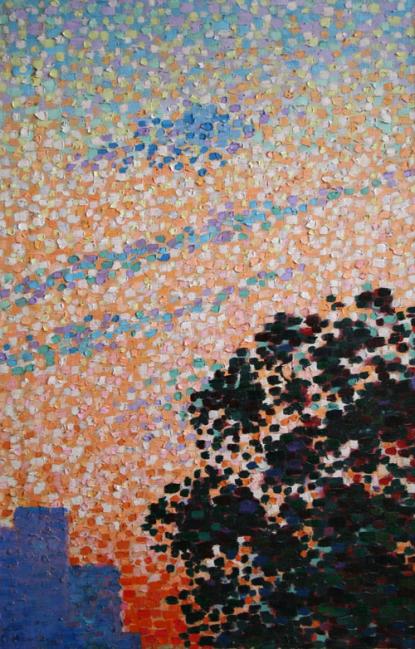
In his abstract fine artworks the dinamics of spirals and weaves are in abundance, as if the prints of the variegation of life. However, the artist does not get lost in the ever-changing processes of life but pays attention to human drama, suffering, intentions. Even more, he directs the attention of the viewers towards these. Despite his symbolism, the center of the pictures is man. The deeper is the insight into his ideas if we focus on the atmosphere and content of the pictures and not formal elements. We can also mention the pure and varied colors that are important for meaning. His unique art does not relate to any of the genres.
He held his first exhibition in Sao Paolo in 1955. Following this, he held exhibitions in other towns of South America until his return to Europe and showed his works in Paris, Vienna, Torino and Munich. He was awarded with the 'Golden Medal' in 1986. He held his first exhibition in Hungary in Jászberény in 1987, then in the Szolnok Gallery with the sculptor Borbereki-Kovács Zoltán.
Before his death in 1993, he donated almost 200 of his works to the Hamza Museum.
|
|