2026. May 23. Saturday
Ferenczy Museum Center - Szentendre Gallery - Szentendre
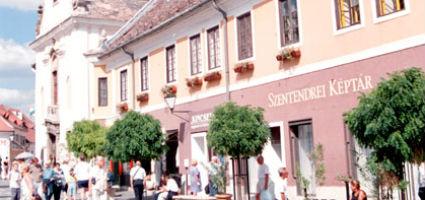 |
Address: 2000, Szentendre Fő tér 2-5.
Phone number: (20) 779-6657
E-mail: info@muzeumicentrum.hu
Opening hours: Thu-Sun 10-18
|
The exhibition has closed for visitors.
2006.09.22. - 2006.10.29.
Share it, if you like it:


Museum tickets, service costs:
|
Ticket for adults
|
3000 HUF
|
|
|
Group ticket for adults
(min. 10 people)
|
2200 HUF
|
/ capita
|
|
Individual ticket for students
|
1500 HUF
|
|
|
Group ticket for students
(min. 10 people)
|
800 HUF
|
/ capita
|
|
Individual ticket for pensioners
|
1500 HUF
|
|
|
Ticket for families
(2 adults + max. 3 children)
|
4000 HUF
|
/ family
|
|
Group guide
|
14000 HUF
|
/ group
|
|
Group guide
|
22000 HUF
|
/ group
|
Modok Mária studied with Modok Réti Istvánn at the Collage of Fine Arts during 1917-1918. After graduation she continued her studies in Nagybánya and Dés. The first time she arrived in Szentendre was in 1929 and she remained connected to the town until the end of her life. She took part in the free school of the Association of the Painters of Szentendre. Her art blossomed out in the town where a artists and guest artists influenced her.
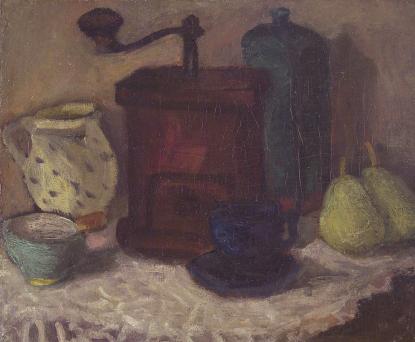
At the beginning, in the 1930's the landscape painter Modok focused on figural painting. She held her first independent and very successful exhibition in the Tamás Gallery in 1935. Social issues motivated her works: the composition eg. about mother and her child symbolized starving workers. Her sensitivity towards social issues put her among the opposition along with her artist friends Derkovits Gyula, Dési Huber István, Mészáros László, Szántó Piroska, József Attila.
Modok married Czóbel Béla in 1940. Their marriage had double affect on her: on one hand she became a supporting character next to her internationally acclaimed husband. On the other hand, she and her husband traveled between Hungary and Paris which trips put her in a fashionable society. Modok got to know a new world she had never dreamed of before. At the beginning, she used the experiences she acquired from the Fauves to whom Czóbel also belonged. Modok was always sensitive to the actual problems of life which sensibility was very useful in Paris.
At the turn of the 1950-60's she gradually began to abstract the spectacle. She made green-purple organized structure of vine and grape, real geometric forms of the view of the houses of a city. The geometric forms filled the surface with motion. Both the method and the way she formed them created the world of the abstraction of reality. She shaped structures that were favored topics of the artists in Hungary. Modok's art had two layers; she was both French and Hungarian and was a typical female artist.
The artist, who lived in spotlight and in the shadow of her husband in the second half of her life, is remembered at the one-man exhibition that presents the turning points in the life and art of Modok Mária via her works and experiments.
At the beginning, in the 1930's the landscape painter Modok focused on figural painting. She held her first independent and very successful exhibition in the Tamás Gallery in 1935. Social issues motivated her works: the composition eg. about mother and her child symbolized starving workers. Her sensitivity towards social issues put her among the opposition along with her artist friends Derkovits Gyula, Dési Huber István, Mészáros László, Szántó Piroska, József Attila.
Modok married Czóbel Béla in 1940. Their marriage had double affect on her: on one hand she became a supporting character next to her internationally acclaimed husband. On the other hand, she and her husband traveled between Hungary and Paris which trips put her in a fashionable society. Modok got to know a new world she had never dreamed of before. At the beginning, she used the experiences she acquired from the Fauves to whom Czóbel also belonged. Modok was always sensitive to the actual problems of life which sensibility was very useful in Paris.
At the turn of the 1950-60's she gradually began to abstract the spectacle. She made green-purple organized structure of vine and grape, real geometric forms of the view of the houses of a city. The geometric forms filled the surface with motion. Both the method and the way she formed them created the world of the abstraction of reality. She shaped structures that were favored topics of the artists in Hungary. Modok's art had two layers; she was both French and Hungarian and was a typical female artist.
The artist, who lived in spotlight and in the shadow of her husband in the second half of her life, is remembered at the one-man exhibition that presents the turning points in the life and art of Modok Mária via her works and experiments.
|
|
|
Related activities
|
|||
