2026. April 4. Saturday
Museum of Textil And Clothing Industry (Textilmuseum) - Budapest
 |
Address: 1036, Budapest Lajos u. 138.
Phone number: (1) 250-1020
E-mail: titkarsag@obudaimuzeum.hu
Opening hours: Tue-Sun 10-18
|
The exhibition has closed for visitors.
2003.06.19. - 2003.10.05.
Share it, if you like it:


Museum tickets, service costs:
|
Ticket for adults
|
450 HUF
|
|
|
Ticket for students
|
400 HUF
|
|
|
Ticket for pensioners
|
400 HUF
|
|
|
Guide
|
2000 HUF
|
|
|
Group guide
(over 6 people)
|
1000 HUF
|
Éva P. Szabó opened her first weaving studio in 1931 in Budapest. She made furnishing fabrics in Hungary first, first on Nyüstös and later on Jacquard looms. She made textile for the best architects of the time such as Lajos Kozma, Gyula Kaesz, Farkas Molnár, and József Vágó. We illustrate this period with material samples and photos.
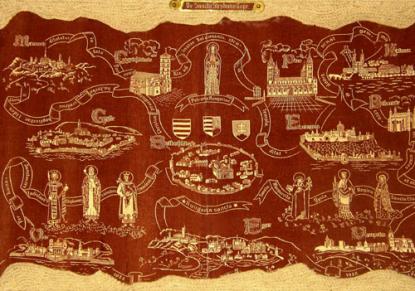
In 1937 she was commissioned by the cathedral of Pécs to make a large vestments of 28 pieces. It was presented at the 900th anniversary of the death of Saint Stephen and the occasion of the Eucharist World Congress in 1938. The Royal Crown influenced the figures ornamenting the chasubles. The visitors may see a sample of the carpet named De Sancto Stephano Rege that pictures Hungarian saints and bishops. According to photos published in contemporary press the textile was used to cover the pulpit at a meeting before the World congress.
The motifs of the large noble embroidery were used in the silk brocade of which the celebration dress of Mrs. Horthy was made. Sample of the textile and the words of the wife of the regent addressing the people with a photo of her are displayed. The brocade made in 1942 is also connected to a significant date: the anniversary of the enthroning of Kink Lajos.
The figurative representation was designed after the codices of Augsburg. The stencil drawing on the brocade is also displayed.
A private collector donated the curtain named "História" made on a Jacquard machine. The figures of King Mathias and Queen Beatrix were inspired by French goblin art. The textile received a bronze medal at the Triennial of Milan in 1940.
Cloths, furniture covers, muslin curtains and cretonne table covers made with hand pressing are shown in one of the interiors. Photos demonstrate material of cloths and ready-made dresses.
In 1937 she was commissioned by the cathedral of Pécs to make a large vestments of 28 pieces. It was presented at the 900th anniversary of the death of Saint Stephen and the occasion of the Eucharist World Congress in 1938. The Royal Crown influenced the figures ornamenting the chasubles. The visitors may see a sample of the carpet named De Sancto Stephano Rege that pictures Hungarian saints and bishops. According to photos published in contemporary press the textile was used to cover the pulpit at a meeting before the World congress.
The motifs of the large noble embroidery were used in the silk brocade of which the celebration dress of Mrs. Horthy was made. Sample of the textile and the words of the wife of the regent addressing the people with a photo of her are displayed. The brocade made in 1942 is also connected to a significant date: the anniversary of the enthroning of Kink Lajos.
The figurative representation was designed after the codices of Augsburg. The stencil drawing on the brocade is also displayed.
A private collector donated the curtain named "História" made on a Jacquard machine. The figures of King Mathias and Queen Beatrix were inspired by French goblin art. The textile received a bronze medal at the Triennial of Milan in 1940.
Cloths, furniture covers, muslin curtains and cretonne table covers made with hand pressing are shown in one of the interiors. Photos demonstrate material of cloths and ready-made dresses.
|
|