2026. October 19. Monday
Ferenc Kazinczy Museum - Sátoraljaújhely
 |
Address: 3980, Sátoraljaújhely Dózsa György u. 11.
Phone number: (47) 322-351
E-mail: info@kazinczymuzeum.hu
Opening hours: Tue-Sun 9-17
|
The exhibition has closed for visitors.
1992.12.13. - 2011.12.31.
Share it, if you like it:


Museum tickets, service costs:
|
Ticket for adults
|
600 HUF
|
|
|
Ticket for students
|
300 HUF
|
|
|
Ticket for pensioners
|
300 HUF
|
|
|
Photography
|
300 HUF
|
|
|
Video
|
300 HUF
|
The first room demonstrates the history of the town up the 18th century. Zemplén used to be the first royal county of the medieval Hungarian state. Újhely received the previleges of a town from the son of Béla IV. in 1261.
The churches played an important role in the cultural life of the town. The only Hungarian monk order, the Paulian order built a monastery here as early as in the 13th century. Patak, Újhely and Hegyalja used to be the source area of the 16th century reformation. The objects of the exhibition recall the richness of the regional Calvinist church.
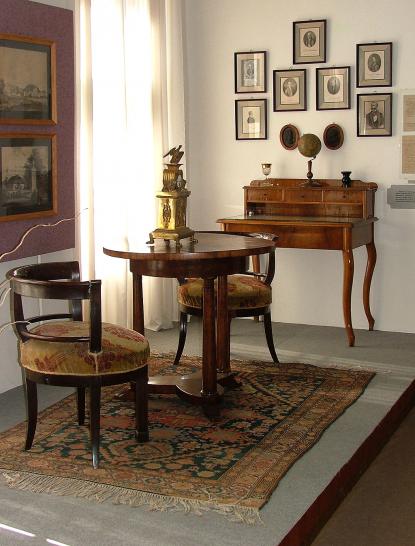
In the second room we enter into the era of the great enlightenment. We refer to the political events of the first part of the 19th century. We can see the enteriour arranged by using the pieces of furniture of Ferenc Kazinczy. In the glasscase we can see the front cover of his most familiar book entitled Thorns and Flowers.
Újhely started to really develop in the first decades of the 19th century. Since 1833 a hospital had functioned in the town. The number of local guilds multiplied, the industry and the merchandise enlivened. The reconstructed enteriour of the Zemplén Casino recalls this age in the third room. The renowned personalities look down on us from the walls.
The child Kossuth completed his elementary schools in Újhely. He began work here as a young lawer. Here he joined the public life and started off his nation-wide career. In the final section of the third room we can see the events of the war fought for the independence (guns, flags, written and printed documents are displayed.). We can read the original copy of the "Declaration of independence", which was made on 19th April 1849.
The churches played an important role in the cultural life of the town. The only Hungarian monk order, the Paulian order built a monastery here as early as in the 13th century. Patak, Újhely and Hegyalja used to be the source area of the 16th century reformation. The objects of the exhibition recall the richness of the regional Calvinist church.
In the second room we enter into the era of the great enlightenment. We refer to the political events of the first part of the 19th century. We can see the enteriour arranged by using the pieces of furniture of Ferenc Kazinczy. In the glasscase we can see the front cover of his most familiar book entitled Thorns and Flowers.
Újhely started to really develop in the first decades of the 19th century. Since 1833 a hospital had functioned in the town. The number of local guilds multiplied, the industry and the merchandise enlivened. The reconstructed enteriour of the Zemplén Casino recalls this age in the third room. The renowned personalities look down on us from the walls.
The child Kossuth completed his elementary schools in Újhely. He began work here as a young lawer. Here he joined the public life and started off his nation-wide career. In the final section of the third room we can see the events of the war fought for the independence (guns, flags, written and printed documents are displayed.). We can read the original copy of the "Declaration of independence", which was made on 19th April 1849.
|
|