2026. May 8. Friday
Ferenczy Museum Center - Szentendre Gallery - Szentendre
 |
Address: 2000, Szentendre Fő tér 2-5.
Phone number: (20) 779-6657
E-mail: info@muzeumicentrum.hu
Opening hours: Thu-Sun 10-18
|
The exhibition has closed for visitors.
2012.03.08. - 2012.04.22.
Share it, if you like it:


Museum tickets, service costs:
|
Ticket for adults
|
3000 HUF
|
|
|
Group ticket for adults
(min. 10 people)
|
2200 HUF
|
/ capita
|
|
Individual ticket for students
|
1500 HUF
|
|
|
Group ticket for students
(min. 10 people)
|
800 HUF
|
/ capita
|
|
Individual ticket for pensioners
|
1500 HUF
|
|
|
Ticket for families
(2 adults + max. 3 children)
|
4000 HUF
|
/ family
|
|
Group guide
|
14000 HUF
|
/ group
|
|
Group guide
|
22000 HUF
|
/ group
|
Barbara Nagy did not choose Szentendre as a home, but she was born into the town's artistic tradition. She learned the visual instruments on the works of Lajos Vajda and Jenő Barcsay as a second language. It is not surprising that even before starting her university studies in 1999, she was voted in the Studio of Young Artists, and in 2000 a member of the Lajos Vajda Studio (VLS). She studied in Dora Maurer’s class at the University of Fine Arts. In her art, the absurd approach of the VLS is well reflected, as well as the impact of Maurer’s works. Her artistic roots are joined by an increased experience of nature: the infinite scenery of the Pilis forests surrounding her home. With the combination of these she determines her own way, and at the same time, she invites the recipient to be a creative partner.
Despite her deep affinity to trees and inclination to crossing borders, Barbara Nagy cannot have such a mystical and fateful relationship to nature, as did Viktorka, the beautiful protagonist of a nineteenth century Czech folk tale's adaptation. Viktorka leaves her earthly body in the night and by moving into a willow in front of their house, she enters a transcendent world. Her husband, the handsome Vitek watches her with incomprehension and disapproval. He cuts the tree away, not suspecting that he also ends the life of his wife. What happens to the hero in the story, the artist themself has to find, using their intellectual sensibility.
Several charcoal drawings of Barbara Nagy show living creatures feeding on water, minerals and light in seemingly absurd situations. Her pictures made of lines and black-and-white structures show stubs of trees broken by storms and cut by man, and lying logs in a strange perspective. The evidences of the vision are questioned in them. The clear possibility of decoding is broken or dimmed. This effect is enhanced by inscriptions with opposite meaning, thus making way for a conceptual approach which raises several questions. Fenced parts on her apparent landscapes are already far from a garden which sometime was associated with protection and homeliness. We do not know why these areas were fenced; they may have closed themselves off from something, or be excluded from somewhere. One thing is certain: the unknown and mysterious terrain calls the late posteriors of Caspar David Friedrich's brooding figures to a lonely wandering full of anxiety.
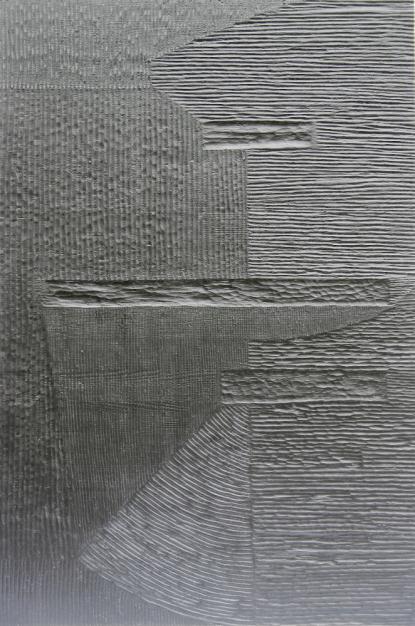
The tree is not only the subject of depiction in the art of Barbara Nagy, but its material is also a challenge not only on her wooden panels, but in her installations as well. The sculpturesque layers of paint in her early paintings were too plastic. Thus she got to the processing of a harder material, wood. The grooves on the black-painted, etched wooden panels are gently undulating, in other parts they run parallel, struggling with the resistance of the material. They were inspired by landscapes at first, but they gradually became nonfigurative. The elements of the compositions which dissolve Malevich's metaphysical black square with grooving do not embody mathematical or geometrical rules, but arise from instinctive and lyrical formation.
The different density and depth of the grooves are like a trap to the light. Changes in the angle of incidence make the picture look radically different, thus making time an important factor in revealing the work. At first glance the surfaces of the panels appear to be homogenous. They gently force the viewer to arouse their meditative sensitivity, which is now rarely practiced. With the help of this and the combined effects of changing light and passing time, the whole image gradually develops.
Judit Mazányi
Despite her deep affinity to trees and inclination to crossing borders, Barbara Nagy cannot have such a mystical and fateful relationship to nature, as did Viktorka, the beautiful protagonist of a nineteenth century Czech folk tale's adaptation. Viktorka leaves her earthly body in the night and by moving into a willow in front of their house, she enters a transcendent world. Her husband, the handsome Vitek watches her with incomprehension and disapproval. He cuts the tree away, not suspecting that he also ends the life of his wife. What happens to the hero in the story, the artist themself has to find, using their intellectual sensibility.
Several charcoal drawings of Barbara Nagy show living creatures feeding on water, minerals and light in seemingly absurd situations. Her pictures made of lines and black-and-white structures show stubs of trees broken by storms and cut by man, and lying logs in a strange perspective. The evidences of the vision are questioned in them. The clear possibility of decoding is broken or dimmed. This effect is enhanced by inscriptions with opposite meaning, thus making way for a conceptual approach which raises several questions. Fenced parts on her apparent landscapes are already far from a garden which sometime was associated with protection and homeliness. We do not know why these areas were fenced; they may have closed themselves off from something, or be excluded from somewhere. One thing is certain: the unknown and mysterious terrain calls the late posteriors of Caspar David Friedrich's brooding figures to a lonely wandering full of anxiety.
The tree is not only the subject of depiction in the art of Barbara Nagy, but its material is also a challenge not only on her wooden panels, but in her installations as well. The sculpturesque layers of paint in her early paintings were too plastic. Thus she got to the processing of a harder material, wood. The grooves on the black-painted, etched wooden panels are gently undulating, in other parts they run parallel, struggling with the resistance of the material. They were inspired by landscapes at first, but they gradually became nonfigurative. The elements of the compositions which dissolve Malevich's metaphysical black square with grooving do not embody mathematical or geometrical rules, but arise from instinctive and lyrical formation.
The different density and depth of the grooves are like a trap to the light. Changes in the angle of incidence make the picture look radically different, thus making time an important factor in revealing the work. At first glance the surfaces of the panels appear to be homogenous. They gently force the viewer to arouse their meditative sensitivity, which is now rarely practiced. With the help of this and the combined effects of changing light and passing time, the whole image gradually develops.
Judit Mazányi
|
|