2026. October 24. Saturday
Budapest Museum of Fine Arts - Budapest
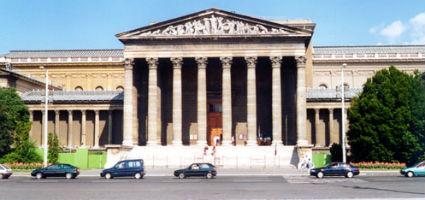 |
Address: 1146, Budapest Dózsa György út 41.
Phone number: (1) 469-7100
E-mail: info@szepmuveszeti.hu
Opening hours: Tue-Sun 10:00-18:00
|
The exhibition has closed for visitors.
2011.05.17. - 2011.09.12.
Share it, if you like it:


Museum tickets, service costs:
|
Ticket for adults
(valid for the permanent exhibitions)
|
2800 HUF
|
/ capita
|
|
Ticket for adults
|
3200 HUF
|
|
|
Group ticket for adults
|
2900 HUF
|
|
|
Ticket for students
(valid for the permanent exhibitions)
|
1400 HUF
|
/ capita
|
|
Ticket for students
|
1600 HUF
|
|
|
Group ticket for students
|
1400 HUF
|
|
|
Ticket for pensioners
(valid for the permanent exhibitions)
|
1400 HUF
|
/ capita
|
|
Audio guide
|
800 HUF
|
|
|
Video
|
1000 HUF
|
The exhibition to run at the Museum of Fine Arts from the middle of May will present works by The Eight, a group of painters closely associated with the international trends that arose in the fine arts at the beginning of the 20th century. The Budapest show comprising some 200 works adopted a reworked concept of the recently closed The Eight in Pécs and will showcase prominent works selected from the Pécs exhibition. Although visitors to the Museum of Fine Arts will see fewer works, some pieces that were not displayed in Pécs will now be included in the Budapest exhibition.
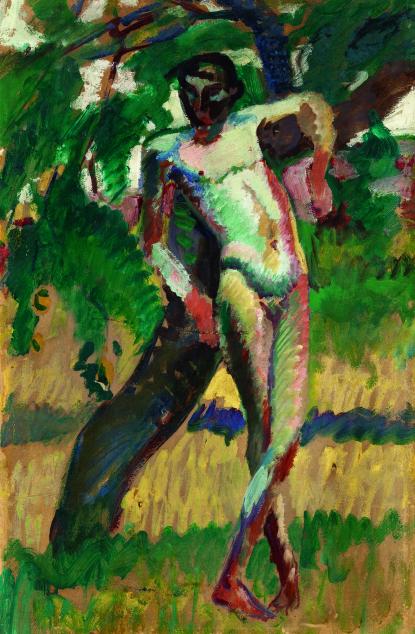
The members of The Eight (Róbert Berény, Dezső Czigány, Béla Czóbel, Károly Kernstok, Ödön Márffy, Dezső Orbán, Bertalan Pór, Lajos Tihanyi) created their own style in the early years of the 20th century, mainly inspired by French Modernism. Their Budapest exhibition in 1909 was a turning point in the history of Hungarian art, since for the first time the public was introduced to a group of young artists whose work was closely associated with the most modern international trends. The painters of the group mostly drew their inspiration from the Fauves, primarily Matisse, and from Cézanne. Their painting style shows a transition from initially relaxed and strong tones to a kind of classicising monumentalism, while the last show of the group, which resulted in their break-up, also included works in the vein of Cubism and, mostly, Expressionism.
The three contemporaneous exhibitions of The Eight were accompanied by cultural events of the highest standard with the active participation of artists and thinkers such as the poet Endre Ady, the composers Béla Bartók and Zoltán Kodály, and the philosopher György Lukács.
The centenary exhibition of The Eight in Budapest closely ties in with the previously staged shows devoted to the group, namely The Hungarian Fauves, organised in 2006 at the Hungarian National Gallery, the highly successful travelling exhibition Fauves Hongrois in France (Céret, Le Cateau-Cambresis, Dijon) in 2008-2009, and The Eight, an exhibition hosted by the city of Pécs and highlighted as a pillar programme of the Pécs European Capital of Culture project.
The Budapest exhibition is a reworked and reorganised version of the Pécs show. While the original concept is unaltered in its main outlines, some details have been refined, concentrating on the most prominent works, and some important masterpieces, which were not displayed in Pécs, have been added. In contrast to the Pécs exhibition, which was aimed at presenting the full range of the group's oeuvre, the Budapest version seeks to provide a comprehensive picture of their work.
The members of The Eight (Róbert Berény, Dezső Czigány, Béla Czóbel, Károly Kernstok, Ödön Márffy, Dezső Orbán, Bertalan Pór, Lajos Tihanyi) created their own style in the early years of the 20th century, mainly inspired by French Modernism. Their Budapest exhibition in 1909 was a turning point in the history of Hungarian art, since for the first time the public was introduced to a group of young artists whose work was closely associated with the most modern international trends. The painters of the group mostly drew their inspiration from the Fauves, primarily Matisse, and from Cézanne. Their painting style shows a transition from initially relaxed and strong tones to a kind of classicising monumentalism, while the last show of the group, which resulted in their break-up, also included works in the vein of Cubism and, mostly, Expressionism.
The three contemporaneous exhibitions of The Eight were accompanied by cultural events of the highest standard with the active participation of artists and thinkers such as the poet Endre Ady, the composers Béla Bartók and Zoltán Kodály, and the philosopher György Lukács.
The centenary exhibition of The Eight in Budapest closely ties in with the previously staged shows devoted to the group, namely The Hungarian Fauves, organised in 2006 at the Hungarian National Gallery, the highly successful travelling exhibition Fauves Hongrois in France (Céret, Le Cateau-Cambresis, Dijon) in 2008-2009, and The Eight, an exhibition hosted by the city of Pécs and highlighted as a pillar programme of the Pécs European Capital of Culture project.
The Budapest exhibition is a reworked and reorganised version of the Pécs show. While the original concept is unaltered in its main outlines, some details have been refined, concentrating on the most prominent works, and some important masterpieces, which were not displayed in Pécs, have been added. In contrast to the Pécs exhibition, which was aimed at presenting the full range of the group's oeuvre, the Budapest version seeks to provide a comprehensive picture of their work.
|
|