2026. June 23. Tuesday
Slovakian National Museum - Slovakian Hungarian Culture Museum - Bratislava
 |
Address: 810 06, Bratislava Zizkova 18
Phone number: (2) 5920-7255
E-mail: mkms@snm.sk
Opening hours: Mon, Wed-Sun 10-17
|
The exhibition has closed for visitors.
2011.02.16. - 2011.04.28.
Share it, if you like it:


Museum tickets, service costs:
|
Ticket for adults
|
40 HUF
|
|
|
Ticket for students
|
20 HUF
|
|
|
Guide
|
100 HUF
|
|
|
Photography
|
100 HUF
|
|
|
Video
|
150 HUF
|
The Metercia of Roznava is to present the history of mining in Roznava, both for the public and the profession. The south slopes of the Szepes-Gömör Ore Mountain, rich in ore, were the reason why mining began in the mountain. Mining influenced the development of villages and towns in the region for centuries.
The first written memories about Roznava date back to King András, when it was mentioned as Rosnoubana. German miners settled in the region arriving from In the 11 and the 13th century Thuringia, Silesia, and Saxony. They came to give a boost to mining industry. The community formed a guild-like organization, though it was based on religion. Penniless miners, often doing paid work also joined the self-support group.
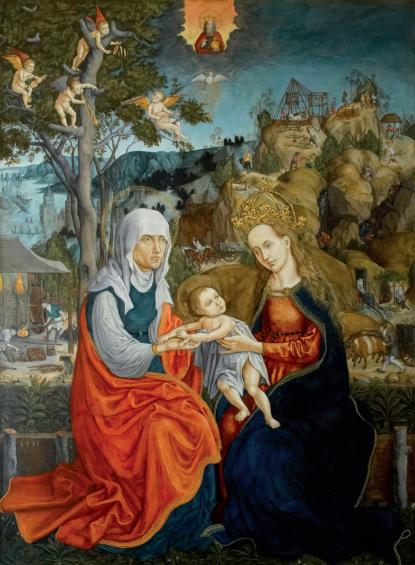
The unparalleled work of art, with documentary value, is often mentioned as Saint Anne and Two Others, otherwise called Metercia in art history and also in mining history literature. The tablet was probably made by members of the group for the church in Roznava.The unknown artist with the initials L. A. most probably wanted to glorify the Holy Trinity, and with this, the work of miners and forgers.
Curators for the Mining Museum in Roznava organized the exhibition 'The Magic of Moulding' to be shown at the museum.
Iron ore mining in the Slovak ore mountain first flourished in the 13th century. At the beginning of the 14th century, metal melting furnaces and forgeries were built, applying water power. The first document to mention the forgery in Csetnek was dated in 1344. Later on, Rimavica, Csetnek and the Sajó Vally were the main centres of iron production. The furnaces operated nearly five-hundred years and iron that came out of them supplied the need of Hungary completely.
The first written memories about Roznava date back to King András, when it was mentioned as Rosnoubana. German miners settled in the region arriving from In the 11 and the 13th century Thuringia, Silesia, and Saxony. They came to give a boost to mining industry. The community formed a guild-like organization, though it was based on religion. Penniless miners, often doing paid work also joined the self-support group.
The unparalleled work of art, with documentary value, is often mentioned as Saint Anne and Two Others, otherwise called Metercia in art history and also in mining history literature. The tablet was probably made by members of the group for the church in Roznava.The unknown artist with the initials L. A. most probably wanted to glorify the Holy Trinity, and with this, the work of miners and forgers.
Curators for the Mining Museum in Roznava organized the exhibition 'The Magic of Moulding' to be shown at the museum.
Iron ore mining in the Slovak ore mountain first flourished in the 13th century. At the beginning of the 14th century, metal melting furnaces and forgeries were built, applying water power. The first document to mention the forgery in Csetnek was dated in 1344. Later on, Rimavica, Csetnek and the Sajó Vally were the main centres of iron production. The furnaces operated nearly five-hundred years and iron that came out of them supplied the need of Hungary completely.
|
|