2026. April 22. Wednesday
Paks Gallery - Paks
 |
Address: 7030, Paks Szent István tér 4.
Phone number: (75) 510-911
E-mail: info@paksikeptar.hu
Opening hours: Winter: Tue 10-16, Wed-Sun 10-17
Summer: Tue 10-16, Wed-Sun 10-18 |
The exhibition has closed for visitors.
2008.09.11. - 2008.11.16.
Share it, if you like it:


Vera Molnar
She studies painting and art history at the Hungarian Collage of Fine Arts from 1942 to 1947. From 1946 to 1947 she stayed in Rome on scholarship. Later on, she moved to Paris with her husband, the psychologist Ferenc Molnár. In 1960, she founded the Groupe de Recherche d'Art Visuelt (GRAV) with Garcia-Rosi Morellet, Francisco Sobrió, Jöel Stein, Yvaral and her husband. In 1967 she was among the founding members of the Art et Informatique Group made u pof employees of the Institut d'Esthétique et des Sciences of Paris. From 1979 she worked at the Atelier de Recherches des Techniques Avancées located in the famous Georges Pompidou Center.
From 1980 to 1990 she worked as an associate professor at the Centre de Recherche Experimental et Informatique des Arts Visuels (Université de Paris I.). She also worked as a professor of fine arts and art history at the Sorbonne in Paris.
In 1948 she did geometric drawings inspired by Dürer’s Melancoly. From 1959 to 1968 she worked with the help of "machine imaginaire" with structures that, just like computers, replace human mind in creative work. In 1968 she became interested in possibilities for artists inherent in computer technology. From 1974 to 1976 she spent her time on working out the "Molnár" Program that is one of the first examples of computer art.
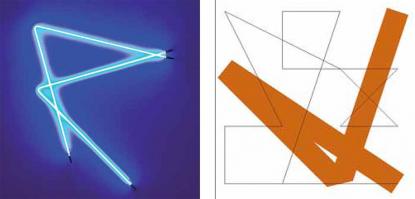
At collage she painted cubist, then abstract pictures. Until the 1950's she was attached to constructivist traditions. From the 1960's, she was interested in the boundary of art and science based on mathematics transforming quadrangles always concentrating on quality change, the "fantastic experience". She used informatics as an accelerator of artistic work but also the tool of breaking from traditional art.
After determining the compositional order of the basic elements, squares and rectangles, designating the limits of endurance she made possible variations of the composition by computer. She began with contour drawings and ended up at the filled forms. She chose the final copy she then put on canvas or in printed form. In her latter works, she applied an inversed process: After the picture was done, she studied further variations with computer.
She was the first to receive the "d..velop digital art award" (DDAA) in Berlin.
François Morellet
The self-studied fine artist, Morellet received his Russian language diploma from the Ecole des Langues Orientales in Paris. He first turned to painting in 1944. His first public appearances were in 1946.
He met the art of Mondrian and Max Bill and gradually turned to abstract and geometric forms. He held his first one-man exhibition in 1950. From 1953 he determined his motifs on mathematical bases. He worked out linear and modular systems that he strictly followed. He met Vera Molnar in 1956.
In 1958 he discovered the importance of chance encounters in artistic processes that turned his interest towards kinetic art. In 1961 he was among the founders of the G.R.A.V. (Groupe de Rechereche d'Art Visuel) group along with Horacio Garcia-Rossi, Julio Le Parc, Francisco Sombrino, Joël Stein, Yvaral. The group that incited the active participation of viewer into the artworks existed until 1968.
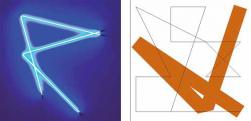
He made his first artworks of neon in the middle of the1960's. He fulfilled his first commission of for a public artwork in 1971. It were followed by a number of artworks for public locations made of aluminium and neon.
In the 1980's he fulfilled he space available for his to the max. His artworks did not end on the canvas but continued on the floor, walls etc.
She studies painting and art history at the Hungarian Collage of Fine Arts from 1942 to 1947. From 1946 to 1947 she stayed in Rome on scholarship. Later on, she moved to Paris with her husband, the psychologist Ferenc Molnár. In 1960, she founded the Groupe de Recherche d'Art Visuelt (GRAV) with Garcia-Rosi Morellet, Francisco Sobrió, Jöel Stein, Yvaral and her husband. In 1967 she was among the founding members of the Art et Informatique Group made u pof employees of the Institut d'Esthétique et des Sciences of Paris. From 1979 she worked at the Atelier de Recherches des Techniques Avancées located in the famous Georges Pompidou Center.
From 1980 to 1990 she worked as an associate professor at the Centre de Recherche Experimental et Informatique des Arts Visuels (Université de Paris I.). She also worked as a professor of fine arts and art history at the Sorbonne in Paris.
In 1948 she did geometric drawings inspired by Dürer’s Melancoly. From 1959 to 1968 she worked with the help of "machine imaginaire" with structures that, just like computers, replace human mind in creative work. In 1968 she became interested in possibilities for artists inherent in computer technology. From 1974 to 1976 she spent her time on working out the "Molnár" Program that is one of the first examples of computer art.
At collage she painted cubist, then abstract pictures. Until the 1950's she was attached to constructivist traditions. From the 1960's, she was interested in the boundary of art and science based on mathematics transforming quadrangles always concentrating on quality change, the "fantastic experience". She used informatics as an accelerator of artistic work but also the tool of breaking from traditional art.
After determining the compositional order of the basic elements, squares and rectangles, designating the limits of endurance she made possible variations of the composition by computer. She began with contour drawings and ended up at the filled forms. She chose the final copy she then put on canvas or in printed form. In her latter works, she applied an inversed process: After the picture was done, she studied further variations with computer.
She was the first to receive the "d..velop digital art award" (DDAA) in Berlin.
François Morellet
The self-studied fine artist, Morellet received his Russian language diploma from the Ecole des Langues Orientales in Paris. He first turned to painting in 1944. His first public appearances were in 1946.
He met the art of Mondrian and Max Bill and gradually turned to abstract and geometric forms. He held his first one-man exhibition in 1950. From 1953 he determined his motifs on mathematical bases. He worked out linear and modular systems that he strictly followed. He met Vera Molnar in 1956.
In 1958 he discovered the importance of chance encounters in artistic processes that turned his interest towards kinetic art. In 1961 he was among the founders of the G.R.A.V. (Groupe de Rechereche d'Art Visuel) group along with Horacio Garcia-Rossi, Julio Le Parc, Francisco Sombrino, Joël Stein, Yvaral. The group that incited the active participation of viewer into the artworks existed until 1968.
He made his first artworks of neon in the middle of the1960's. He fulfilled his first commission of for a public artwork in 1971. It were followed by a number of artworks for public locations made of aluminium and neon.
In the 1980's he fulfilled he space available for his to the max. His artworks did not end on the canvas but continued on the floor, walls etc.
|
|