2026. August 27. Thursday
Millenáris - Budapest
 |
Address: 1024, Budapest Fény u. 20-22.
Phone number: (1) 336-4044, (1) 336-4076
E-mail: info@csodakpalotaja.hu
Opening hours: The Palace of Wonders: Mon-Sun 10-17, Sat-Sun 10-18
|
The exhibition has closed for visitors.
2003.07.01. - 2003.07.20.
Share it, if you like it:


Museum tickets, service costs:
|
Ticket for adults
|
1400 HUF
|
|
|
Group ticket for adults
(min. 4 people)
|
1250 HUF
|
|
|
Group ticket for students
|
900 HUF
|
/ capita
|
|
Ticket for children
|
1100 HUF
|
|
|
Ticket for pensioners
|
1100 HUF
|
|
|
Ticket for families
(max. 6 people)
|
3900 HUF
|
/ family
|
Csaba Pál is an artist of the most versatile branches: drawing, installation, graphics, photography, digital techniques. In addition, he does not even use the techniques used in certain fields in a "pure" way. Among the works made by different techniques there is hardly any similarity in style. These works are connected by the permanent art work and permanent modification.
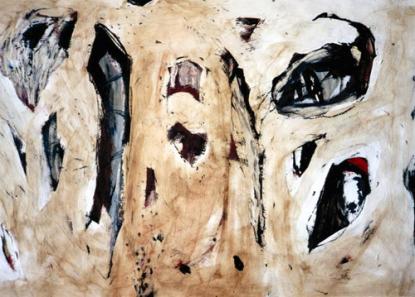
The works are made through several steps. He works on them for a while, then puts them aside to dry. Later he puts some more to them or sometimes takes things away from them. The works places on paper are so thick now as leather.
That is how we get to the key definition of Csaba Pál's art: layers. Csaba Pál seemingly returns to the same place always. He always starts from the beginning. That is how the different phases of work are layered on top of one another. By the side of the dynamic and thick brush lines there appear very mild and thin pencil lines as well. Depending on the angle and distance we look at these pictures, different details will be emphasized.
Anna Bálványos - art historian
The works are made through several steps. He works on them for a while, then puts them aside to dry. Later he puts some more to them or sometimes takes things away from them. The works places on paper are so thick now as leather.
That is how we get to the key definition of Csaba Pál's art: layers. Csaba Pál seemingly returns to the same place always. He always starts from the beginning. That is how the different phases of work are layered on top of one another. By the side of the dynamic and thick brush lines there appear very mild and thin pencil lines as well. Depending on the angle and distance we look at these pictures, different details will be emphasized.
Anna Bálványos - art historian
|
|