2026. May 2. Saturday
Budapest Gallery Exhibition Hall - Budapest
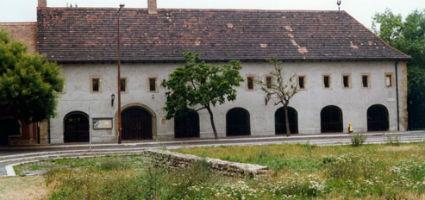 |
Address: 1036, Budapest Lajos u. 158.
Phone number: (1) 388-6784
E-mail: info@budapestgaleria.hu
Opening hours: Tue-Sun 10-18
|
The exhibition has closed for visitors.
2011.07.07. - 2011.08.07.
Share it, if you like it:


... first, I have to mention the series Oil Drop Nebulas that sheds light in the will of the artist. It is exactly what it is: the oil patches on the asphalt that spread so much that they are so thin that can hardly be observed without a microscope. These oil patches are raised into the rank of tablettes. The series on display, thanks to the light grains in the black tar making the background for the 'lead characters' reveal their similarities to the popular and spectacular deep-space photography that we have only available only recently.
What comes to mind right away is space mists of various scenery when we look at the Oil Drops. Next, we consider them, the Oil Drops as proof of occult theories, since our intention was directed to correspondences of gigantic expansions and ordinary experience. Then again, we hit the ground again: in two photos, the oil spots by the white lines painted on the roads, here as minimalist geometric elements posing as estranging motifs deconstruct the idea we had on the first view.
Lehel Endre Paksi: What we tend to see in the pictures in the series 'Lightfish' are strange, vibrating deep-sea creatures. Nevertheless, looking at the photos, we may remember the nebulae electronic interference images, and also the secrets of making digital pictures while the starting point is again an "analogous" chrome disc that is bent this time and not span and which put light reflexes of the sun on the paper, or the objective of the camera.
Finally, as a closure to cosmic landscape filtered through media art we may conclude that images by Július educate is almost about the same as Douglas Adams' dolphins: the world is what it is and not what we usually take it for through our usual lenses and filters. Intergalactic creatures in the series The Hitchhiker's Guide to the Galaxy' playing with dolphins who spend their time with observation and games instead of wars and killing may provide for an excellent motto for a visual art series the humour of which and changes of perspective in it is are not that far from modern natural sciences and the media archaeology of Kittler: - Good by, and thanks for the fish.
Sándor Hornyik
What comes to mind right away is space mists of various scenery when we look at the Oil Drops. Next, we consider them, the Oil Drops as proof of occult theories, since our intention was directed to correspondences of gigantic expansions and ordinary experience. Then again, we hit the ground again: in two photos, the oil spots by the white lines painted on the roads, here as minimalist geometric elements posing as estranging motifs deconstruct the idea we had on the first view.
Lehel Endre Paksi: What we tend to see in the pictures in the series 'Lightfish' are strange, vibrating deep-sea creatures. Nevertheless, looking at the photos, we may remember the nebulae electronic interference images, and also the secrets of making digital pictures while the starting point is again an "analogous" chrome disc that is bent this time and not span and which put light reflexes of the sun on the paper, or the objective of the camera.
Finally, as a closure to cosmic landscape filtered through media art we may conclude that images by Július educate is almost about the same as Douglas Adams' dolphins: the world is what it is and not what we usually take it for through our usual lenses and filters. Intergalactic creatures in the series The Hitchhiker's Guide to the Galaxy' playing with dolphins who spend their time with observation and games instead of wars and killing may provide for an excellent motto for a visual art series the humour of which and changes of perspective in it is are not that far from modern natural sciences and the media archaeology of Kittler: - Good by, and thanks for the fish.
Sándor Hornyik
|
|