2026. April 4. Saturday
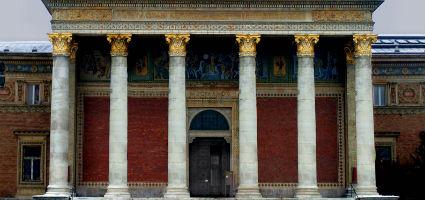
Kunsthalle - Budapest
 |
Address: 1146, Budapest Dózsa György út 37.
Phone number: (1) 460-7000, (1) 363-2671
E-mail: info@mucsarnok.hu
Opening hours: Tue-Wed 10-18, Thu 12-20, Fri-Sun 10-18
|
The exhibition has closed for visitors.
2008.09.26. - 2008.11.09.
Share it, if you like it:


Museum tickets, service costs:
|
Ticket for adults
|
1200 HUF
|
|
|
Ticket for adults
(valid for the Kunsthalle and the Ernst Museum)
|
1400 HUF
|
|
|
Group ticket for adults
(from over 10 people)
|
800 HUF
|
/ capita
|
|
Ticket for students
(EU citizens from the age of 6 to 26 )
|
600 HUF
|
|
|
Ticket for students
(valid for the Kunsthalle and the Ernst Museum, 6-26 years of age)
|
700 HUF
|
|
|
Group ticket for students
(from over 10 people)
|
400 HUF
|
/ capita
|
|
Ticket for pensioners
(valid for the Kunsthalle and the Ernst Museum, 62-70 years of age)
|
700 HUF
|
|
|
Ticket for pensioners
(EU citizens from the age of 62 to 70)
|
600 HUF
|
|
|
Ticket for families
(1 adults + 2 children)
|
1800 HUF
|
/ family
|
|
Ticket for families
(2 adults + 2 children)
|
2400 HUF
|
/ family
|
Mircea Cantor makes his first long-awaited solo appearance with Future Gifts in Hungary. Beside the five works selected from the last few years including video- and film installations (Deeparture, 2006, Shadow for a while, 2007) the artist presents a new 7-piece sculptural installation entitled 7 Future Gifts, inspired by a small ceramic installation he exhibited at Studio Protokoll (Cluj Napoca, Romania) in 2006.

Shaped by a largely untraceable mix of simple (many times absurd) observations and intimate findings from his familial and professional environments (both in France and Romania) on the one hand and supported by an appreciation for unpredictability on the other, Cantor's works can, at first sight, puzzle the viewer with their apparent simplicity and bluntness. Viewers soon realize, however, that they have entered unsteady terrains and the seductive sense of anonymity and simplicity unfold into a rather layered and complex set of connections and relations.
The genuine playfulness, and a certain mischievous character - with surprising twists often tinted with irony - which inform Cantor's work help both to keep one's distance and to give new perspective to the observed phenomena. His works are poetic layerings that do leave a few traces to intrigue the viewer about the complexity of his transformations.
The sequence of the works presented in the Kunsthalle further articulates the intertwining duality of unpretentious material presence and latency leading to the new work 7 Future Gifts, a set of gigantic to more modestly sized "air" boxes; emptiness gift wrapped into 7 precisely composed geometrical structures, which maintain their individuality, each carrying a ribbon of different fashion.
Upon entering to receive these "gifts" one will most probably feel a mixture of agitation, expectation, surprise and uncertainty. A bit of an "Alice in Wonderland"-ish feel is also smuggled in, however, to test our ability to assimilate surprise, as well as to make us remember things we may have wished for at unusual moments and/or places.
Mircea Cantor was born in Oradea (Romania). He lives and works in Paris.
Shaped by a largely untraceable mix of simple (many times absurd) observations and intimate findings from his familial and professional environments (both in France and Romania) on the one hand and supported by an appreciation for unpredictability on the other, Cantor's works can, at first sight, puzzle the viewer with their apparent simplicity and bluntness. Viewers soon realize, however, that they have entered unsteady terrains and the seductive sense of anonymity and simplicity unfold into a rather layered and complex set of connections and relations.
The genuine playfulness, and a certain mischievous character - with surprising twists often tinted with irony - which inform Cantor's work help both to keep one's distance and to give new perspective to the observed phenomena. His works are poetic layerings that do leave a few traces to intrigue the viewer about the complexity of his transformations.
The sequence of the works presented in the Kunsthalle further articulates the intertwining duality of unpretentious material presence and latency leading to the new work 7 Future Gifts, a set of gigantic to more modestly sized "air" boxes; emptiness gift wrapped into 7 precisely composed geometrical structures, which maintain their individuality, each carrying a ribbon of different fashion.
Upon entering to receive these "gifts" one will most probably feel a mixture of agitation, expectation, surprise and uncertainty. A bit of an "Alice in Wonderland"-ish feel is also smuggled in, however, to test our ability to assimilate surprise, as well as to make us remember things we may have wished for at unusual moments and/or places.
Mircea Cantor was born in Oradea (Romania). He lives and works in Paris.
|
|
