2026. April 18. Saturday
The exhibition has closed for visitors.
2006.08.16. - 2006.09.17.
Share it, if you like it:


"...we never really have a direct relation with the world surrounding us. We all live and work in a model of the world that our own brain produced." (Marvin Minsky)
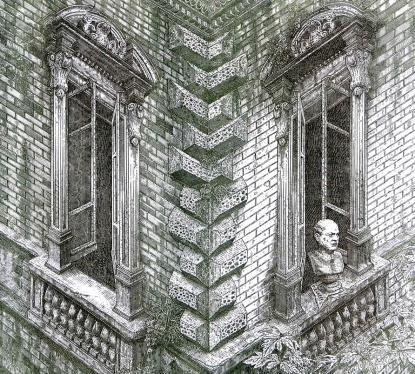
Orosz first showed his art in 1970. He is an active participant at many fields of fine art: he makes autonomous and duplicated graphics (mainly etching and illustrations), designs applied graphics, (posters) he paints, creates three dimensional objects and installations. He is also known of his animations.
The Hungarian artist also known abroad has held several important exhibitions in many countries: in 1997 Thessalonica (Greece) in the ward of the Aristotelian University; in 1998 at the Bethlehem University of Pennsylvania at the Payne Gallery, in 2000 in Silkeborg (Sweden), the Kunst Center and in 2002 in Bratislava in the Slovakian National Gallery. Orosz István is the only Hungarian artist whose work is included in the Tate in London.
An important feature of his work is the making of posters to exhibitions, films and plays. He tries to influence his senses with his ‘anamorphoses’. In his sign system, the viewer faces infinite spaces facing or connecting to each other through absurd structures, endless labyrinths and lack of meaning. With the changes of forms, he embarrasses the viewer. His sources are the works of Arcimboldo, Escher, Magritte.
The fake perspectives and illusions of spectacle that look like perfectly accounted for lead the viewer to suspect the relativity of human existence, the rational boundary of the perception of reality. The viewer plays just as an important part in the revival of the works as the artist, Orosz István, himself. Orosz questions the information that reaches us even on this level of perception. Thus, he also questions the credibility of the opinion we form.
The exhibition of the Ernst Museum is apt to somewhat show separately but still in context the varied fields of the art of Orosz. A catalogue with many pictures and with many of the writings of Orosz István was also made to accompany the display.
One of the favored means of Orosz is the mirror. His system made of them is a real surprising experience. Distortion, mirroring, reflection are the broken pieces of reality. Whole. Part. At the end the TRACE.
Since the all mirrors preserve the print of all faces that once dipped into its lights. Alice in Wonderland! Let us just remember!
The exhibition provides this experience in a separate ward.
Orosz first showed his art in 1970. He is an active participant at many fields of fine art: he makes autonomous and duplicated graphics (mainly etching and illustrations), designs applied graphics, (posters) he paints, creates three dimensional objects and installations. He is also known of his animations.
The Hungarian artist also known abroad has held several important exhibitions in many countries: in 1997 Thessalonica (Greece) in the ward of the Aristotelian University; in 1998 at the Bethlehem University of Pennsylvania at the Payne Gallery, in 2000 in Silkeborg (Sweden), the Kunst Center and in 2002 in Bratislava in the Slovakian National Gallery. Orosz István is the only Hungarian artist whose work is included in the Tate in London.
An important feature of his work is the making of posters to exhibitions, films and plays. He tries to influence his senses with his ‘anamorphoses’. In his sign system, the viewer faces infinite spaces facing or connecting to each other through absurd structures, endless labyrinths and lack of meaning. With the changes of forms, he embarrasses the viewer. His sources are the works of Arcimboldo, Escher, Magritte.
The fake perspectives and illusions of spectacle that look like perfectly accounted for lead the viewer to suspect the relativity of human existence, the rational boundary of the perception of reality. The viewer plays just as an important part in the revival of the works as the artist, Orosz István, himself. Orosz questions the information that reaches us even on this level of perception. Thus, he also questions the credibility of the opinion we form.
The exhibition of the Ernst Museum is apt to somewhat show separately but still in context the varied fields of the art of Orosz. A catalogue with many pictures and with many of the writings of Orosz István was also made to accompany the display.
One of the favored means of Orosz is the mirror. His system made of them is a real surprising experience. Distortion, mirroring, reflection are the broken pieces of reality. Whole. Part. At the end the TRACE.
Since the all mirrors preserve the print of all faces that once dipped into its lights. Alice in Wonderland! Let us just remember!
The exhibition provides this experience in a separate ward.
|
|
