2026. February 18. Wednesday
The Diocese Museum of Székesfehérvár - Székesfehérvár
 |
Address: 8000, Székesfehérvár Városház tér 4.
Phone number: (22) 510-698, (22) 510-681
E-mail: muzeum@szfvar.katolikus.hu
Opening hours: Tue-Sat 10-18
|
The exhibition has closed for visitors.
2006.02.25. - 2007.08.01.
Share it, if you like it:


Museum tickets, service costs:
|
Ticket for adults
|
980 HUF
|
|
|
Group ticket for adults
(20 people)
|
15800 HUF
|
|
|
Ticket for students
|
640 HUF
|
|
|
Group ticket for students
(20 people)
|
10200 HUF
|
|
|
Ticket for pensioners
|
640 HUF
|
|
|
Group ticket for pensioners
(20 people)
|
10200 HUF
|
|
|
Ticket for families
|
2920 HUF
|
/ family
|
Prohászka Ottokár was a not uncompromising pure man living in evangelic simplicity. These features of his personality made the organizers chose the aqua colored plexiglass. The modern, elegant material that is not vain a slight bit creates the illusion of floating. The pure plexiglass does not drive the attention of the viewer away from the 'inherent' values, in this case from the personal objects of Prohászka Ottokár and documents in connection with him. The material was not only used in the wards but also are the bearers of the photos that with the right lighting glow from within showing the stations of the bishop of fiery soul.
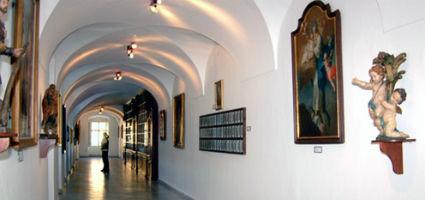
The exhibition is divided into three main units. In the corridors the life of Prohászka Ottokár are shown in chronological order accompanied with contemporary documents. In the second unit, in the wards, we recall varied aspects of the oeuvre of the talented individual. Besides being an artist and working in the church, we focused on his puritan soul, his simplicity, his determining and positive characteristics that make him a credible symbol.
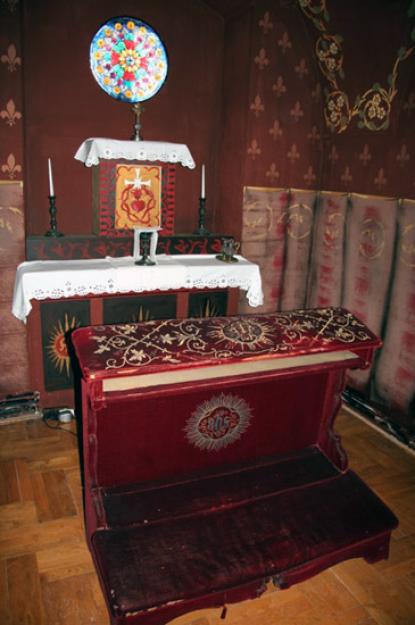
The thirds unit is a stylized chapel. It is impossible to show Prohászka Ottokár without recalling his soul in prayer. He fed on the Holy Communion, his fine soul was nourished by it. Almost all his deeds lead back to two chapels where he spent 22 years. These two sacrificed places are the seminar of Esztergom and the Bishop Palace of Székesfehérvár. His personal relation with Jesus formed at these two places and made him rise among the greatest saints. Thus, the window of the chapel revives that of the walls of the seminar of Esztergom, the design on the walls the Episcopal chapel.
The lighting of the display emphasizes the above described unity. The focus on certain events with the appropriate lighting on the corridors, uniformly lit walls and wards and half-lit chapel serve to enhance the view. After the visit to the exhibition wards and the chapel, teh visitors may see films of Prohászka Ottokár. On the computer, they may also learn more details of the exhibition.
Though this present exhibition about Prohászka Ottokár is the more detailed ever since of the change of the regime, we have to state that the display titled "Prohászka - Bishop for Man" did not intend to give a complete review of Prohászka Ottokár. We only wished to show a few important elements by which we reflect overall. We would like to help the Christians of the 21st century and the visitors to the museum in general in learning about the bishop who led the life of a saint. We wished they understood that his life was a road enlightened before us.
The exhibition is divided into three main units. In the corridors the life of Prohászka Ottokár are shown in chronological order accompanied with contemporary documents. In the second unit, in the wards, we recall varied aspects of the oeuvre of the talented individual. Besides being an artist and working in the church, we focused on his puritan soul, his simplicity, his determining and positive characteristics that make him a credible symbol.
The thirds unit is a stylized chapel. It is impossible to show Prohászka Ottokár without recalling his soul in prayer. He fed on the Holy Communion, his fine soul was nourished by it. Almost all his deeds lead back to two chapels where he spent 22 years. These two sacrificed places are the seminar of Esztergom and the Bishop Palace of Székesfehérvár. His personal relation with Jesus formed at these two places and made him rise among the greatest saints. Thus, the window of the chapel revives that of the walls of the seminar of Esztergom, the design on the walls the Episcopal chapel.
The lighting of the display emphasizes the above described unity. The focus on certain events with the appropriate lighting on the corridors, uniformly lit walls and wards and half-lit chapel serve to enhance the view. After the visit to the exhibition wards and the chapel, teh visitors may see films of Prohászka Ottokár. On the computer, they may also learn more details of the exhibition.
Though this present exhibition about Prohászka Ottokár is the more detailed ever since of the change of the regime, we have to state that the display titled "Prohászka - Bishop for Man" did not intend to give a complete review of Prohászka Ottokár. We only wished to show a few important elements by which we reflect overall. We would like to help the Christians of the 21st century and the visitors to the museum in general in learning about the bishop who led the life of a saint. We wished they understood that his life was a road enlightened before us.
|
|