2026. March 2. Monday
Fullstop Half a century at Vásárhely Human Educational Centre - Hódmezővásárhely
 |
Address: 6800, Hódmezővásárhely Andrássy út 34.
Phone number: (62) 530-940
E-mail: emlekpont@emlekpont.hu
Opening hours: Tue-Sun 10-17
|
The exhibition has closed for visitors.
2012.02.22. - 2012.03.25.
Share it, if you like it:


Museum tickets, service costs:
|
Ticket for adults
|
800 HUF
|
|
|
Group ticket for adults
(over 15 people)
|
600 HUF
|
|
|
Ticket for students
|
400 HUF
|
|
|
Group ticket for students
(over 15 people)
|
300 HUF
|
|
|
Ticket for pensioners
|
400 HUF
|
|
|
Group ticket for pensioners
(over 15 people)
|
300 HUF
|
|
|
Guide
|
3000 HUF
|
|
|
Guide
|
5000 HUF
|
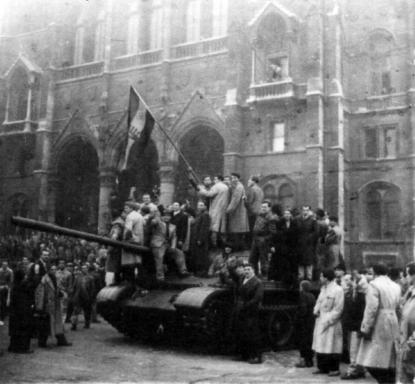
The largest anti-Soviet uprising in history, the revolution of 1956 in Hungary and the Poznań June is commemorated by the Poznań Section for the National Memory Institute of Poland and its Hungarian partners. The exhibition is illustrated by 32 photos.
Demonstrations by workers demanding better conditions, salary raise and against deprivation began on June 28 1956 with demonstrations that gradually turned into a revolutionary movement.
Workers for the Joseph Stalin Metal Industries took the streets demanding pay compensation and some freedom concessions, marching towards the city centre. Since party leaders did not negotiate with them, they entered the building.
To halt spreading the uprising, the powers sent armoured forces of 3000 with orders to attack. 47 people fell victim of the attack, among the 13-year-old boy Romek Strzałkowski, who was shot from ambush.
Two hundred people were imprisoned during reprisal. However, the protest was an important milestone in Polish history: Polish communists chose a new leader: the Polish Imre Nagy ’Gomulka’. The communist authorities censored all information on the Poznań events for a quarter of a century.
The Poznań uprising preceded the fight of Hungarians for freedom from communist dictatorship. On 23 1956 October Technical University students decided to demonstrate to express their solidarity for Poland. The demonstration set off a chain of events that changed world history.
At the beginning of the Hungarian revolution, Polish people felt an even stronger solidarity. Many Polish people literary gave their blood: an enormous amount of donations and blood arrived from Poland in the capital of Hungary, Budapest under siege. These two tragic events strengthened the affinity between these two nations.
The contemporary documents commemorate the heroes and victims of Poznań and Budapest. In addition, the visitors will also find a number of objects from 1956: Polish samizdat publications, and some tiny objects from Budapest.
Demonstrations by workers demanding better conditions, salary raise and against deprivation began on June 28 1956 with demonstrations that gradually turned into a revolutionary movement.
Workers for the Joseph Stalin Metal Industries took the streets demanding pay compensation and some freedom concessions, marching towards the city centre. Since party leaders did not negotiate with them, they entered the building.
To halt spreading the uprising, the powers sent armoured forces of 3000 with orders to attack. 47 people fell victim of the attack, among the 13-year-old boy Romek Strzałkowski, who was shot from ambush.
Two hundred people were imprisoned during reprisal. However, the protest was an important milestone in Polish history: Polish communists chose a new leader: the Polish Imre Nagy ’Gomulka’. The communist authorities censored all information on the Poznań events for a quarter of a century.
The Poznań uprising preceded the fight of Hungarians for freedom from communist dictatorship. On 23 1956 October Technical University students decided to demonstrate to express their solidarity for Poland. The demonstration set off a chain of events that changed world history.
At the beginning of the Hungarian revolution, Polish people felt an even stronger solidarity. Many Polish people literary gave their blood: an enormous amount of donations and blood arrived from Poland in the capital of Hungary, Budapest under siege. These two tragic events strengthened the affinity between these two nations.
The contemporary documents commemorate the heroes and victims of Poznań and Budapest. In addition, the visitors will also find a number of objects from 1956: Polish samizdat publications, and some tiny objects from Budapest.
|
|