2026. May 24. Sunday
Geographic Museum of the Tuszazug - Tiszaföldvár
|
|
Address: 5430, Tiszaföldvár Kossuth u. 101.
Phone number: (56) 470-135, (56) 570-525
E-mail: tf.muzeum@gmail.com
Opening hours: Tue-Sat 9-12, 13-17
On prior notice: beyond the opening hours as well! |
The exhibition has closed for visitors.
2006.09.08. - 2006.10.01.
Share it, if you like it:


Museum tickets, service costs:
|
Ticket for adults
|
300 HUF
|
|
|
Group ticket for adults
(min. 10 people)
|
150 HUF
|
|
|
Ticket for students
|
150 HUF
|
|
|
Ticket for children
|
150 HUF
|
|
|
Ticket for pensioners
|
150 HUF
|
|
|
Guide
|
2000 HUF
|
|
|
Photography
|
2000 HUF
|
|
|
Video
|
5000 HUF
|
The temporary exhibition titled 'The Jewelry of the Seas' opened in the Geography Museum of Tiszazug on 8 September 2006. The display open until 1 October was organized by the museologist Varga András.
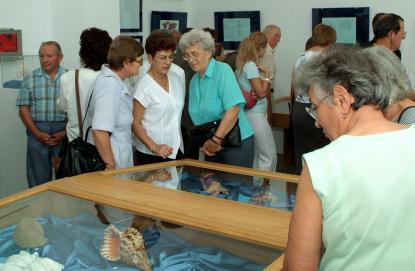
The photos of the diver photographer Dombovári Tibor who won the "Best feature" Prize with his pictures are shown on the walls of the wards. The photos conjure up an unbelievable mixture of color and form of the seas. 12 wars are classified according to zones and communities of life (Boreal and Mediterranean zone, Zanzibar, South-Africa, Indo-Pacific, Indian Ocean, Japan, Florida, Australia and Cuba). We show 284 species of snails and shell specimens. We are happy to announce that the heirs of the founder of the museum, dr. Varga Lajos (1913-2003), put the nicest pieces of his Mollusca collection at the museum’s disposal.
The visitors may read of the history of the snail collection of the Móra Ferenc Museum (continental, fresh water, sea): the collection continuously grew in the past 120 years and now int counts 140 pieces.
The expanatory text explains that the number of the genre of snails is over 100 000, the shells is over 20 000. The food specialties made of oyster etc. are often on the menu of countries by the sea. The largest pearl of the world, 7 kg, was found in 1934 at the coasts of the Philippines. The porcelain snails were used as a currency in many countries of the Asia, Polynesia and Africa. The Romans used the skeleton as flute.
The exhibition provides many other interesting features that let us learn about these pieces of interest of the seas.
Túri Zoltán
The photos of the diver photographer Dombovári Tibor who won the "Best feature" Prize with his pictures are shown on the walls of the wards. The photos conjure up an unbelievable mixture of color and form of the seas. 12 wars are classified according to zones and communities of life (Boreal and Mediterranean zone, Zanzibar, South-Africa, Indo-Pacific, Indian Ocean, Japan, Florida, Australia and Cuba). We show 284 species of snails and shell specimens. We are happy to announce that the heirs of the founder of the museum, dr. Varga Lajos (1913-2003), put the nicest pieces of his Mollusca collection at the museum’s disposal.
The visitors may read of the history of the snail collection of the Móra Ferenc Museum (continental, fresh water, sea): the collection continuously grew in the past 120 years and now int counts 140 pieces.
The expanatory text explains that the number of the genre of snails is over 100 000, the shells is over 20 000. The food specialties made of oyster etc. are often on the menu of countries by the sea. The largest pearl of the world, 7 kg, was found in 1934 at the coasts of the Philippines. The porcelain snails were used as a currency in many countries of the Asia, Polynesia and Africa. The Romans used the skeleton as flute.
The exhibition provides many other interesting features that let us learn about these pieces of interest of the seas.
Túri Zoltán
|
|
|
Related activities
|
|
