2026. June 9. Tuesday
Collection of Local History of Ferencváros - Budapest
|
|
Address: 1092, Budapest Ráday u. 18. (bejárat az Erkel u. 15. felől)
Phone number: (1) 218-7420
E-mail: ferencvarosigyujtemeny@gmail.com
Opening hours: Tue-Fri 12-18, Sat 10-14
|
The exhibition has closed for visitors.
2013.05.14. - 2013.06.01.
Share it, if you like it:


Alphons ter Avest
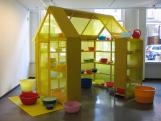
In the work van Alphons ter Avest perception and transformation play an important role. He tries to make images that are clear and transparant, with a multi-layered meaning. He uses everyday objects like a car, a caravan or a house as a basis. These icons of our time initiate the proces, but are not a model. He is modelling these images, renewing them to catch their miraculous ambiguity.
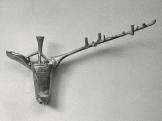
He mostly works with reproduction-technics, like silkscreenprinting and metal casting, using templates and moulds.
Anke Land
Anke Land makes photographs, drawings and wall hangings. Her way of working is for the greater part a mental process, the results of which she sets down in pictures, that she covers and traces in drawing. The centre of gravity in her work are the wall hangings she makes in the Audax Textiel Museum in Tilburg, Holland.
Often newspaperpictures lie at the basis of her work. She neutralizes the concept of time by depicting daily news as actual history in the old craftmanship of tapestry.
The modern loom is steered by computer, but still according to the system of the Fleming Jacquard, who - in the 18th century - had his looms steered by punched cards.
The result is historicising: nowadays pictures become archetypes of human appearances throughout the ages.
You find the same tension between actuality and history in the skulls, which are simultaneously portrait and mask.
Temporality and eternity united in a blink of the eye. Pictures on the edge of life and death, but part of our lives. Anke Land makes drawings, paintings, images and monumental works. For a while now she has added works of textile, and can make the multiple layers in her work tangible and understandable with the help of a computerized weaving technique. She designs tapestries which have been realised at the Textile Museum in Tilburg (Holland). She considers this technique as an extension of her possibilities to intensify her expressive skill. Earlier on in her career she applied graphic and photographic techniques to this end, and she considers the weaving as an extension of thatAnke Land makes photographs, drawings and wall hangings. Her way of working is for the greater part a mental process, the results of which she sets down in pictures, that she covers and traces in drawing. The centre of gravity in her work are the wall hangings she makes in the Audax Textiel Museum in Tilburg, Holland.
Often newspaperpictures lie at the basis of her work. She neutralizes the concept of time by depicting daily news as actual history in the old craftmanship of tapestry.
The modern loom is steered by computer, but still according to the system of the Fleming Jacquard, who - in the 18th century - had his looms steered by punched cards.
The result is historicising: nowadays pictures become archetypes of human appearances throughout the ages.
You find the same tension between actuality and history in the skulls, which are simultaneously portrait and mask.
Temporality and eternity united in a blink of the eye. Pictures on the edge of life and death, but part of our lives.
Anke Land makes photographs, drawings and wall hangings. Her way of working is for the greater part a mental process, the results of which she sets down in pictures, that she covers and traces in drawing. The centre of gravity in her work are the wall hangings she makes in the Audax Textiel Museum in Tilburg, Holland.
Often newspaperpictures lie at the basis of her work. She neutralizes the concept of time by depicting daily news as actual history in the old craftmanship of tapestry.
The modern loom is steered by computer, but still according to the system of the Fleming Jacquard, who - in the 18th century - had his looms steered by punched cards.
The result is historicising: nowadays pictures become archetypes of human appearances throughout the ages.
You find the same tension between actuality and history in the skulls, which are simultaneously portrait and mask.
Temporality and eternity united in a blink of the eye. Pictures on the edge of life and death, but part of our lives.
Elizabet de Vaal
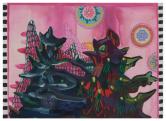
De Vaal sources her work in texts, diagrams and images, often found in unfamiliar environments encountered in her many travels and artist residencies. Her curiosity and fascination with unknown spaces and histories, lead to the creation of enigmatic paintings and in situ multimedia works. Since 2004, de Vaal lives and works for part of the year in Hungary, where she taught at the Faculty of Fine Arts at the University of Pécs.
Pier Pennings
Visual reality in its most concrete form is always present in Pier Penning’s work. Everything is tangible and earthy. Balancing between desolation and intimacy, the image acquires an indefinable value. There is a tension between two extremes: the definable and the indeterminable. Pennings always shows epheremality of nature and the works of man. Be it in his drawings and pictures of soil structures, patterns of branches and empty rooms in deserted buildings, be it in his pictures of adapted and distorted cars and car models. He is always searching for the emotion of the passing, hidden behind the so called reality of what we consider to be objective and constant. In his studio he uses very concrete materials, like plastic, steel, stone, plaster and tapes. As a photographer he uses light as the sculptor of secrets.
Desiree de Baar
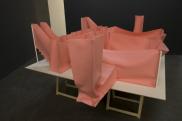
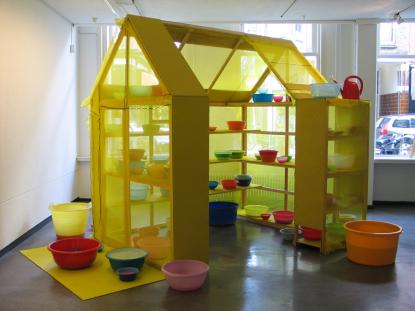
Spaces fascinate Desiree de Baar. These can be lived-in rooms in a house or building, but also specific, tough, masculine rooms such as a prison cell or an observation post. She wants to make these spaces her own. She does this by exaggerating some parts, details so ordinary they escape the notice of others, or by displacing the rooms to a gallery or museum where she transforms their character. Thereby she creates alienation. The viewer has to backtrack. His assumptions are thrown to the wind. His faded imagination is stirred. The media Desiree de Baar uses are wallpaper, felt, embroidery and knitting. Media that the viewer might not automatically associate with fine art. On the contrary. She complements them with drawings and sketches.
Pietertje van Splunter
Anke Land makes photographs, drawings and wall hangings. Her way of working is for the greater part a mental process, the results of which she sets down in pictures, that she covers and traces in drawing. The centre of gravity in her work are the wall hangings she makes in the Audax Textiel Museum in Tilburg, Holland.
Often newspaperpictures lie at the basis of her work. She neutralizes the concept of time by depicting daily news as actual history in the old craftmanship of tapestry.
The modern loom is steered by computer, but still according to the system of the Fleming Jacquard, who - in the 18th century - had his looms steered by punched cards.
The result is historicising: nowadays pictures become archetypes of human appearances throughout the ages.
You find the same tension between actuality and history in the skulls, which are simultaneously portrait and mask.
Temporality and eternity united in a blink of the eye. Pictures on the edge of life and death, but part of our lives.
Pietertje van Splunter werkt in public space, in het own projects and in commissions. For these commissions she mostly works as "BROOS", together with het partner Zeger Reyers. She is co-organiser of the artists-initiative Quartair in The Hague. She also makes autonomous works. In these works she plays with the boundaries of painting and the painting. It’s all about the idea of "expanded painting" where painting and not-painting overlap each other. The work developes originates form the attitude of a painter, but surpasses the demarcation between painting, sculpture, installation, architecture or the new media.
He mostly works with reproduction-technics, like silkscreenprinting and metal casting, using templates and moulds.
Anke Land
Anke Land makes photographs, drawings and wall hangings. Her way of working is for the greater part a mental process, the results of which she sets down in pictures, that she covers and traces in drawing. The centre of gravity in her work are the wall hangings she makes in the Audax Textiel Museum in Tilburg, Holland.
Often newspaperpictures lie at the basis of her work. She neutralizes the concept of time by depicting daily news as actual history in the old craftmanship of tapestry.
The modern loom is steered by computer, but still according to the system of the Fleming Jacquard, who - in the 18th century - had his looms steered by punched cards.
The result is historicising: nowadays pictures become archetypes of human appearances throughout the ages.
You find the same tension between actuality and history in the skulls, which are simultaneously portrait and mask.
Temporality and eternity united in a blink of the eye. Pictures on the edge of life and death, but part of our lives. Anke Land makes drawings, paintings, images and monumental works. For a while now she has added works of textile, and can make the multiple layers in her work tangible and understandable with the help of a computerized weaving technique. She designs tapestries which have been realised at the Textile Museum in Tilburg (Holland). She considers this technique as an extension of her possibilities to intensify her expressive skill. Earlier on in her career she applied graphic and photographic techniques to this end, and she considers the weaving as an extension of thatAnke Land makes photographs, drawings and wall hangings. Her way of working is for the greater part a mental process, the results of which she sets down in pictures, that she covers and traces in drawing. The centre of gravity in her work are the wall hangings she makes in the Audax Textiel Museum in Tilburg, Holland.
Often newspaperpictures lie at the basis of her work. She neutralizes the concept of time by depicting daily news as actual history in the old craftmanship of tapestry.
The modern loom is steered by computer, but still according to the system of the Fleming Jacquard, who - in the 18th century - had his looms steered by punched cards.
The result is historicising: nowadays pictures become archetypes of human appearances throughout the ages.
You find the same tension between actuality and history in the skulls, which are simultaneously portrait and mask.
Temporality and eternity united in a blink of the eye. Pictures on the edge of life and death, but part of our lives.
Anke Land makes photographs, drawings and wall hangings. Her way of working is for the greater part a mental process, the results of which she sets down in pictures, that she covers and traces in drawing. The centre of gravity in her work are the wall hangings she makes in the Audax Textiel Museum in Tilburg, Holland.
Often newspaperpictures lie at the basis of her work. She neutralizes the concept of time by depicting daily news as actual history in the old craftmanship of tapestry.
The modern loom is steered by computer, but still according to the system of the Fleming Jacquard, who - in the 18th century - had his looms steered by punched cards.
The result is historicising: nowadays pictures become archetypes of human appearances throughout the ages.
You find the same tension between actuality and history in the skulls, which are simultaneously portrait and mask.
Temporality and eternity united in a blink of the eye. Pictures on the edge of life and death, but part of our lives.
Elizabet de Vaal
De Vaal sources her work in texts, diagrams and images, often found in unfamiliar environments encountered in her many travels and artist residencies. Her curiosity and fascination with unknown spaces and histories, lead to the creation of enigmatic paintings and in situ multimedia works. Since 2004, de Vaal lives and works for part of the year in Hungary, where she taught at the Faculty of Fine Arts at the University of Pécs.
Pier Pennings
Visual reality in its most concrete form is always present in Pier Penning’s work. Everything is tangible and earthy. Balancing between desolation and intimacy, the image acquires an indefinable value. There is a tension between two extremes: the definable and the indeterminable. Pennings always shows epheremality of nature and the works of man. Be it in his drawings and pictures of soil structures, patterns of branches and empty rooms in deserted buildings, be it in his pictures of adapted and distorted cars and car models. He is always searching for the emotion of the passing, hidden behind the so called reality of what we consider to be objective and constant. In his studio he uses very concrete materials, like plastic, steel, stone, plaster and tapes. As a photographer he uses light as the sculptor of secrets.
Desiree de Baar
Spaces fascinate Desiree de Baar. These can be lived-in rooms in a house or building, but also specific, tough, masculine rooms such as a prison cell or an observation post. She wants to make these spaces her own. She does this by exaggerating some parts, details so ordinary they escape the notice of others, or by displacing the rooms to a gallery or museum where she transforms their character. Thereby she creates alienation. The viewer has to backtrack. His assumptions are thrown to the wind. His faded imagination is stirred. The media Desiree de Baar uses are wallpaper, felt, embroidery and knitting. Media that the viewer might not automatically associate with fine art. On the contrary. She complements them with drawings and sketches.
Pietertje van Splunter
Anke Land makes photographs, drawings and wall hangings. Her way of working is for the greater part a mental process, the results of which she sets down in pictures, that she covers and traces in drawing. The centre of gravity in her work are the wall hangings she makes in the Audax Textiel Museum in Tilburg, Holland.
Often newspaperpictures lie at the basis of her work. She neutralizes the concept of time by depicting daily news as actual history in the old craftmanship of tapestry.
The modern loom is steered by computer, but still according to the system of the Fleming Jacquard, who - in the 18th century - had his looms steered by punched cards.
The result is historicising: nowadays pictures become archetypes of human appearances throughout the ages.
You find the same tension between actuality and history in the skulls, which are simultaneously portrait and mask.
Temporality and eternity united in a blink of the eye. Pictures on the edge of life and death, but part of our lives.
Pietertje van Splunter werkt in public space, in het own projects and in commissions. For these commissions she mostly works as "BROOS", together with het partner Zeger Reyers. She is co-organiser of the artists-initiative Quartair in The Hague. She also makes autonomous works. In these works she plays with the boundaries of painting and the painting. It’s all about the idea of "expanded painting" where painting and not-painting overlap each other. The work developes originates form the attitude of a painter, but surpasses the demarcation between painting, sculpture, installation, architecture or the new media.
|
|