2026. June 9. Tuesday
Pál Kiss Museum - Tiszafüred
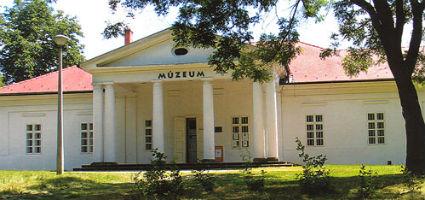 |
Address: 5350, Tiszafüred Tariczky sétány 6.
Phone number: (59) 352-106
E-mail: kisspalmuz@gmail.com
Opening hours: Tue-Sat 9-12, 13-17
|
The exhibition has closed for visitors.
2013.04.02. - 2013.04.30.
Share it, if you like it:


Museum tickets, service costs:
|
Ticket for adults
|
500 HUF
|
/ capita
|
|
Group ticket for adults
(min. 10 people)
|
150 HUF
|
/ capita
|
|
Ticket for students
|
250 HUF
|
/ capita
|
|
Ticket for pensioners
|
250 HUF
|
/ capita
|
|
Ticket for families
(2 adults + max. 3 children)
|
750 HUF
|
/ family
|
|
Program ticket
|
300 HUF
|
/ capita
|
|
Season ticket
|
1000 HUF
|
|
|
Group guide
(max. 40 people)
|
2000 HUF
|
/ group
|
|
Photography
|
1000 HUF
|
|
|
Video
|
1000 HUF
|
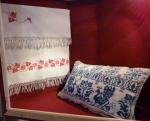
In our exhibition we dispayed two hand-made embroideries. It is well known that the basic material for embroidery was handwoven homespun or purchase linen and the motifs or patterns were seavn by young girls or young women as a household activity during the 19th century or in the first half of the 20th century.
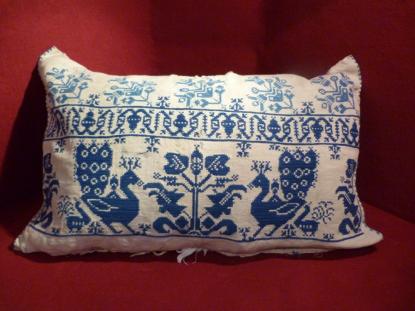
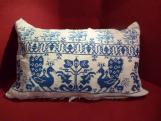
The first displayed product is a pillowslip. Its material is made of hemp and the decoration is made by the technique of the so-called ‘oblique cross stitch’ embroidery, which is a sort of the cross stitch technique. Two peacock cross stitch patterns create the central part of the decoration, which is devided by a seven-branched flower. There are borders on the top of the central band. This is the so-called ‘mesterke’ (in Hungarian). Acorn or oak-nut forms and seven-branched flowers are embroidered on the ‘mesterke’. All these patterns are blue. This pillowslip was embroidered by Etelka Sarkady at the beginning of the 20th century. Later she became the wife of Mr. László Schleiminger (1893-1966), who lived in Tiszafüred.
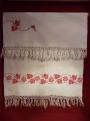
The second textile is also a woven, decorated material. It is an embroidered apron made by Margit Borsós (later the wife of József Saflánszki) when she was a young girl at around 1930. The patterns are made by cross-stitch technique which was a popular form of counter-thread embroidery all over the country.
Translated by István Vadász
The first displayed product is a pillowslip. Its material is made of hemp and the decoration is made by the technique of the so-called ‘oblique cross stitch’ embroidery, which is a sort of the cross stitch technique. Two peacock cross stitch patterns create the central part of the decoration, which is devided by a seven-branched flower. There are borders on the top of the central band. This is the so-called ‘mesterke’ (in Hungarian). Acorn or oak-nut forms and seven-branched flowers are embroidered on the ‘mesterke’. All these patterns are blue. This pillowslip was embroidered by Etelka Sarkady at the beginning of the 20th century. Later she became the wife of Mr. László Schleiminger (1893-1966), who lived in Tiszafüred.
The second textile is also a woven, decorated material. It is an embroidered apron made by Margit Borsós (later the wife of József Saflánszki) when she was a young girl at around 1930. The patterns are made by cross-stitch technique which was a popular form of counter-thread embroidery all over the country.
Translated by István Vadász
|
|