2026. June 9. Tuesday
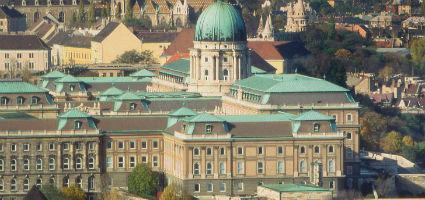
Budapest History Museum - Budapest
 |
Address: 1014, Budapest Szent György tér 2.
Phone number: (1) 487-8800, (1) 487-8801
E-mail: btm@mail.btm.hu
Opening hours: Tue-Sun 10-18
|
The exhibition has closed for visitors.
2012.04.12. - 2012.05.13.
Share it, if you like it:


Museum tickets, service costs:
|
Ticket for adults
|
2000 HUF
|
|
|
Ticket for students
|
1000 HUF
|
|
|
Group ticket for students
(over 10 people)
|
500 HUF
|
|
|
Ticket for pensioners
|
1000 HUF
|
|
|
Ticket for families
|
2200 HUF
|
/ family
|
|
Group guide
(up to 20 people)
|
7000 HUF
|
|
|
Group guide
(20-30 people)
|
9500 HUF
|
|
|
Group guide
|
14000 HUF
|
|
|
Group guide
|
18000 HUF
|
|
|
Audio guide
|
1200 HUF
|
|
|
Photography
|
1000 HUF
|
The exhibition presents photos by the Swiss diplomat Carl Lutz (1895-1975) of Budapest in 1942-1945. Lutz worked as an assistant consul in Budapest those days, representing one of the most important states at war. He oversaw emigration requests to Palestinian mandate region, representing Great Brittan. His office was located in Szabadság Square, at the American Embassy's building. His residence was located in Werbőczy Street.
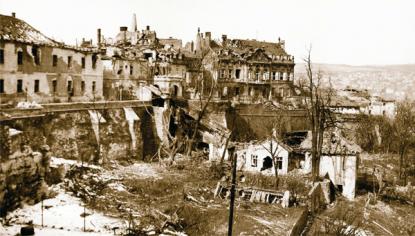
The passionate amateur still photographer, Lutz, spent most of his time in 1944 saving Jewish people for which work he was awarded the title Righteous Among the Nations. The exhibition presents shortly, with a few photographs Carl Lutz’s life and work. The visitors can also see some relics and documents in showcases that are shown for the first time.
Most of the material, however, is photos he took in Budapest. Some of them are of well-known site in town, though with a special approach, showing a friendly town and people who knew nothing of the war.
The second section deals with the bombings and then the destroyed parts of the town. E.g. there are photos of the building of the British Embassy before the bombings, in its ’best days’, with the Swiss flag over the facade, and the same building after the bombings. One of Lutz’s most well-known photo was made from a house basement destroyed with bombs.
The last photos are from 1949 when Lutz, who had been formerly banished from Hungary, returned in 1945 to marry Magdolna Csány. They were both hiding in the Castle during the air raid of Budapest.
The exhibition was organized by György Vámos president of the Carl Lutz Foundation
The photos are from the ETH Archiv für Zeitgeschichte and Agnes Hirschi.
The passionate amateur still photographer, Lutz, spent most of his time in 1944 saving Jewish people for which work he was awarded the title Righteous Among the Nations. The exhibition presents shortly, with a few photographs Carl Lutz’s life and work. The visitors can also see some relics and documents in showcases that are shown for the first time.
Most of the material, however, is photos he took in Budapest. Some of them are of well-known site in town, though with a special approach, showing a friendly town and people who knew nothing of the war.
The second section deals with the bombings and then the destroyed parts of the town. E.g. there are photos of the building of the British Embassy before the bombings, in its ’best days’, with the Swiss flag over the facade, and the same building after the bombings. One of Lutz’s most well-known photo was made from a house basement destroyed with bombs.
The last photos are from 1949 when Lutz, who had been formerly banished from Hungary, returned in 1945 to marry Magdolna Csány. They were both hiding in the Castle during the air raid of Budapest.
The exhibition was organized by György Vámos president of the Carl Lutz Foundation
The photos are from the ETH Archiv für Zeitgeschichte and Agnes Hirschi.
|
|
