2026. June 9. Tuesday
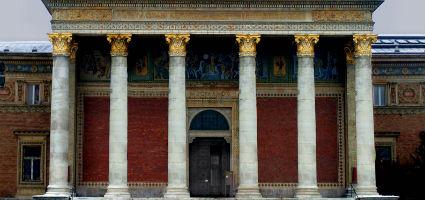
Kunsthalle - Budapest
 |
Address: 1146, Budapest Dózsa György út 37.
Phone number: (1) 460-7000, (1) 363-2671
E-mail: info@mucsarnok.hu
Opening hours: Tue-Wed 10-18, Thu 12-20, Fri-Sun 10-18
|
The exhibition has closed for visitors.
2012.01.26. - 2012.03.25.
Share it, if you like it:


Museum tickets, service costs:
|
Ticket for adults
|
1200 HUF
|
|
|
Ticket for adults
(valid for the Kunsthalle and the Ernst Museum)
|
1400 HUF
|
|
|
Group ticket for adults
(from over 10 people)
|
800 HUF
|
/ capita
|
|
Ticket for students
(EU citizens from the age of 6 to 26 )
|
600 HUF
|
|
|
Ticket for students
(valid for the Kunsthalle and the Ernst Museum, 6-26 years of age)
|
700 HUF
|
|
|
Group ticket for students
(from over 10 people)
|
400 HUF
|
/ capita
|
|
Ticket for pensioners
(valid for the Kunsthalle and the Ernst Museum, 62-70 years of age)
|
700 HUF
|
|
|
Ticket for pensioners
(EU citizens from the age of 62 to 70)
|
600 HUF
|
|
|
Ticket for families
(1 adults + 2 children)
|
1800 HUF
|
/ family
|
|
Ticket for families
(2 adults + 2 children)
|
2400 HUF
|
/ family
|
He is 71 years old, he does not like what is antique, at least not what was made before 1950, and he is dreaming about a bedroom that is completely empty and white. He was born in France, as a child he wished to be a missionary, and he was suspended for a week at the art school of Nice for defending Picasso against his fellow students. In the early sixties he painted his works with his feet on the floor, and in his first recorded performance he had himself photographed among dustbins. After moving to New York he lived in Soho and made his furniture from plywood that he found in the streets. He worked as theatre set designer, poet, sculptor, and he also wrote a ballet based on vertical stage technique. His straight-curving-broken-infinite pipes and bars were exhibited in many halls and parks around the world, he had a performance in Budapest, and also composed music in which shots were fired. In 1983 a film was made about him.
According to his ars poetica, "it is only through taking risks that one may reach that which is worth showing."
Accordingly, his performances and exhibitions, which tend to provoke the public taste, are capable of moving masses of people. One of his famous artworks, a 60 tons composition of rusty iron bars that creates the bare ribs of a metal-being, framing the statue of Louis XIV, which was made in the workshop of Nyársapáti and exhibited in Versailles this autumn, gained significant media coverage. It was impetuously called "a piercing put in Mona Lisa's ears", while simultaneously praised for its implementation as showing a level of engineering expertise comparable to that behind the viaduct of Millau.
Every summer he moves from his lofty New York apartment to his estate in Provance, where he is helped by the Hungarian-born László Szalai. Here his gallery is placed at the former site of chicken-houses and a factory workshop: it is here that his wall-reliefs inspired by spontaneous graffiti and raw emotions are moulded. In 1989 he was awarded with the Grand Prize of the City of Paris, and later, in 2005 he received the French Legion of Honour.
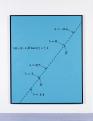
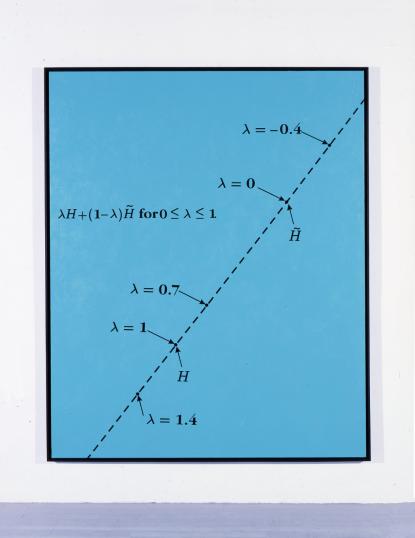
He made his first tar-based monochrome pictures in 1961, relying on materials - like tar, industrial paint, cardboard - that are much less sophisticated than the traditional materials of painting. His early work as a sculptor is characterized by a similar approach and the use of clumps of coal and pebbles. Though his art took a new direction after his moving to New York, he still rejected the tradition of panel painting: his pictures were inspired by mechanically reproduced, enlarged mathematical formulas, industrial drawings and scientific formulas. He produced artistic adaptations of the main fields of the natural sciences in a four-year program (1967-1971), after which he abandoned artistic work altogether in order to devote himself to exhibiting and explaining his works in lectures held all over the world. In the meantime, he also taught art theory at Sorbonne.
The present retrospective exhibition at Kunsthalle aims at serving with a comprehensive view of the astonishingly coherent oeuvre of an artist belonging to the forefront of the minimalist and conceptualist movements, whose oeuvre ranges from pieces of a radically new perspective created 50 years ago in New York to the large-scale masterpieces recently displayed in Versailles.
According to his ars poetica, "it is only through taking risks that one may reach that which is worth showing."
Accordingly, his performances and exhibitions, which tend to provoke the public taste, are capable of moving masses of people. One of his famous artworks, a 60 tons composition of rusty iron bars that creates the bare ribs of a metal-being, framing the statue of Louis XIV, which was made in the workshop of Nyársapáti and exhibited in Versailles this autumn, gained significant media coverage. It was impetuously called "a piercing put in Mona Lisa's ears", while simultaneously praised for its implementation as showing a level of engineering expertise comparable to that behind the viaduct of Millau.
Every summer he moves from his lofty New York apartment to his estate in Provance, where he is helped by the Hungarian-born László Szalai. Here his gallery is placed at the former site of chicken-houses and a factory workshop: it is here that his wall-reliefs inspired by spontaneous graffiti and raw emotions are moulded. In 1989 he was awarded with the Grand Prize of the City of Paris, and later, in 2005 he received the French Legion of Honour.
He made his first tar-based monochrome pictures in 1961, relying on materials - like tar, industrial paint, cardboard - that are much less sophisticated than the traditional materials of painting. His early work as a sculptor is characterized by a similar approach and the use of clumps of coal and pebbles. Though his art took a new direction after his moving to New York, he still rejected the tradition of panel painting: his pictures were inspired by mechanically reproduced, enlarged mathematical formulas, industrial drawings and scientific formulas. He produced artistic adaptations of the main fields of the natural sciences in a four-year program (1967-1971), after which he abandoned artistic work altogether in order to devote himself to exhibiting and explaining his works in lectures held all over the world. In the meantime, he also taught art theory at Sorbonne.
The present retrospective exhibition at Kunsthalle aims at serving with a comprehensive view of the astonishingly coherent oeuvre of an artist belonging to the forefront of the minimalist and conceptualist movements, whose oeuvre ranges from pieces of a radically new perspective created 50 years ago in New York to the large-scale masterpieces recently displayed in Versailles.
|
|