2026. June 9. Tuesday
Black House - Szeged
|
|
Address: 6720, Szeged Somogyi utca 13.
Phone number: (62) 425-033
E-mail: info@mfm.u-szeged.hu
Opening hours: Mon-Wed 10-18, Thu 10-20, Fri-Sun 10-18
|
The exhibition has closed for visitors.
2012.01.24. - 2012.05.31.
Share it, if you like it:


Museum tickets, service costs:
|
Ticket for adults
|
1290 HUF
|
|
|
Ticket for students
|
690 HUF
|
|
|
Ticket for pensioners
(under 65 years of age)
|
690 HUF
|
|
|
Ticket for families
(2 adults + 3 children)
|
2990 HUF
|
/ family
|
|
Guide
|
5000 HUF
|
The first calendars covering an entire year appeared in the 16th century. At the beginning, calendars mainly informed people on religious holidays or astrological predictions. Later on, however, they also contained practical advice about everyday life. By the 19th century, calendars were there in almost every household, and have been there ever since.
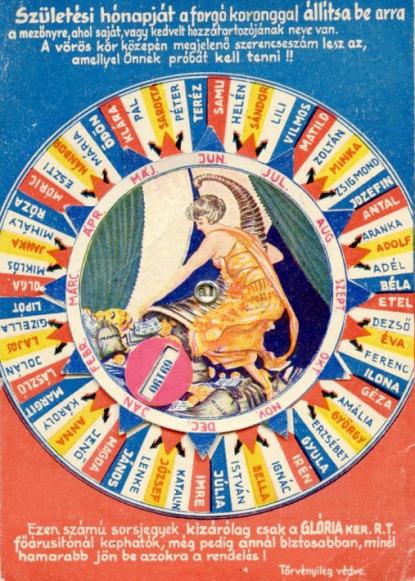
The exhibition reveals the history, development and changes in calendars from the 19th century to these days. The earliest item is the Grünn-Orbán calendar from 1813, but there is one from 1853 edited by Mór. By the beginning of the 20th century, calendars also included advertisements. There is a calendar mostly created for purposes of propaganda, called Treasury Calendar from the 1950s.
In addition to these, the visitors' memory is evoked by s-called card calendars, calendars advertising national factories, often with women dressed in flimsy cloths, e.g. calendars for Olympos or ÁFÉSZ. The material comprises of calendars up to the 21st century, both Hungarian and national ones. There is for example a silver coin with a circle calendar on it from the year 2000.
In addition to the calendars, the visitors will find the artwork of the month, a material dealing with 1848 and a concert on the first museum week in 2012.
The exhibition reveals the history, development and changes in calendars from the 19th century to these days. The earliest item is the Grünn-Orbán calendar from 1813, but there is one from 1853 edited by Mór. By the beginning of the 20th century, calendars also included advertisements. There is a calendar mostly created for purposes of propaganda, called Treasury Calendar from the 1950s.
In addition to these, the visitors' memory is evoked by s-called card calendars, calendars advertising national factories, often with women dressed in flimsy cloths, e.g. calendars for Olympos or ÁFÉSZ. The material comprises of calendars up to the 21st century, both Hungarian and national ones. There is for example a silver coin with a circle calendar on it from the year 2000.
In addition to the calendars, the visitors will find the artwork of the month, a material dealing with 1848 and a concert on the first museum week in 2012.
|
|